




Copy trading is often marketed as an effortless way to profit by simply following professional traders. But the reality is far more complex. When I first started copy trading, I expected easy returns—only to lose money repeatedly through costly mistakes.
In this article, I’ll share 8 copy trading mistakes I made personally so you can avoid the same pitfalls. Whether you’re a complete beginner or struggling to see consistent profits, these lessons will help you trade smarter.
- Why beginners fail at copy trading
- Common traps: rankings, dangerous strategies, and misleading metrics
- How to set stop losses and take profits effectively
- Real-world lessons and actionable solutions
Why Beginners Fail at Copy Trading: My 8 Costly Mistakes
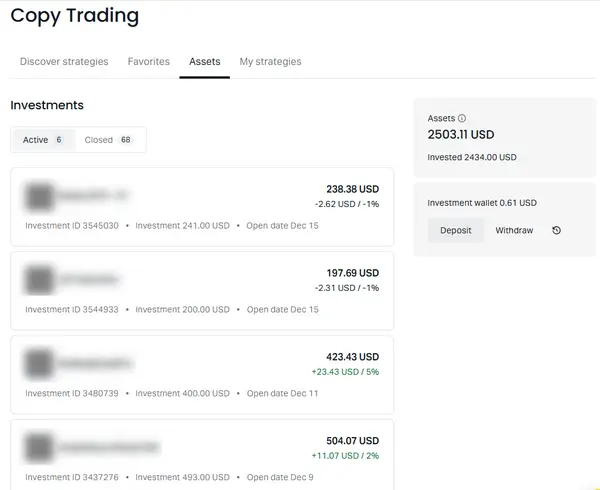
I started copy trading seriously in 2025. In my first month alone, I closed 68 positions—and the results were humbling.
| Metric | Value |
|---|---|
| Initial Capital | $2,500 |
| Current Total Equity | $2,504 |
| Realized P/L | -$66 |
| Unrealized P/L | +$70 |
| Net Result | +$4 (+0.16%) |
Honestly? I’m basically break-even.
My worst single trade lost $207. I’ve experienced every mistake in this article firsthand. I’m sharing these lessons so you don’t have to learn the hard way.
Here are the 8 copy trading mistakes that cost me money—and how to avoid them.
Mistake #1: Trusting Profit Rates and Rankings Blindly
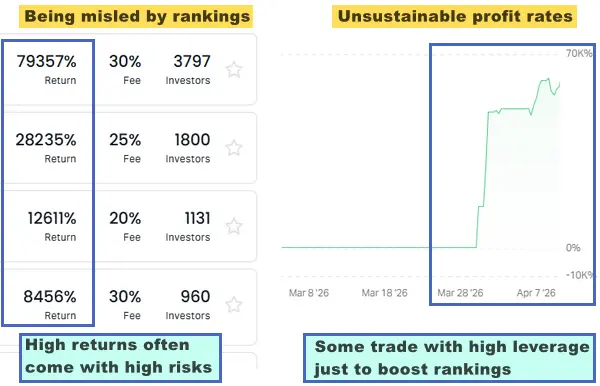
When I started copy trading, I focused heavily on platform rankings. Every broker displays high-profit traders at the top, so I assumed top-ranked traders must be the best.
I was wrong.
Many top-ranked traders achieve those returns through high-risk strategies over short periods. I followed one trader showing 100% monthly returns—only to watch my account suffer a massive drawdown weeks later.
The reality: You must look beyond profit percentages. Check trading history, maximum drawdown, and how long they’ve been trading. Don’t be lazy—do your due diligence.
The Dark Side of Profit Percentages
Let me show you why profit rates can be dangerously misleading.
I found a trader with over 10,000% all-time returns. “Someone who 100x’d their account?” Sounds impressive—and that’s exactly why they rank highly.
But their total profit? Only about $400.
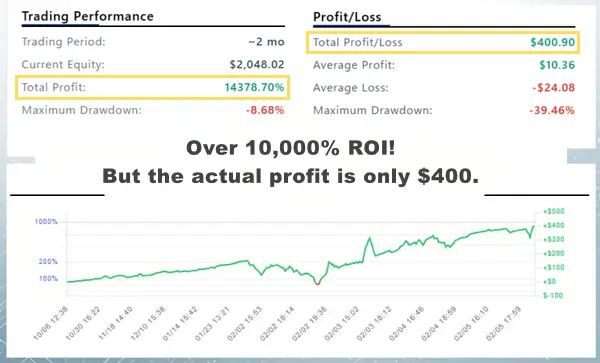
How is this possible? They started with just $20-30. When $30 becomes $300, that’s a 1,000% return—even though the actual profit is tiny.
This trader later deposited more funds, bringing their current equity to about $2,000. Subtract the $400 profit, and they’ve invested roughly $1,600 of their own money. The real return on their actual capital? About 25%.
Platform statistics show the trader’s account performance—not what you can expect when you copy them.
Mistake #2: Choosing Traders With Short Track Records
Following traders with only 1-2 months of history was another major mistake.
Traders with impressive short-term results often got lucky with favorable market conditions—or they’re using dangerous strategies that haven’t blown up yet.
The trader I followed performed well for the first month. But when market conditions changed, they suffered consecutive losses that wiped out all previous gains.
High-risk traders typically blow up within a few months. Look for at least 3-6 months of verified track record. Long-term consistency is the true test of skill.
Mistake #3: Falling for Averaging Down and Martingale Strategies
I found a trader with a beautiful upward-sloping equity curve. “This person is consistent,” I thought. So I followed them.
Big mistake.
They weren’t actually good at trading. They were just hiding losses by averaging down and using Martingale position sizing.
Averaging down means adding to losing positions to lower your average entry price. Martingale means doubling position size after each loss. Both strategies can work when markets reverse—but when they don’t, losses snowball catastrophically.
One day, this trader suffered a massive drawdown that erased months of profits. Never judge a trader by their equity curve alone. Always analyze their trading history.
Mistake #4: Ignoring Long-Term Sustainability
When you find a profitable trader, it’s tempting to assume the returns will continue forever. But traders who consistently profit for more than a year are extremely rare.
Even scalpers—whose short holding times seem “safer”—can suffer sudden drawdowns. I followed a scalper thinking their strategy was low-risk. Then a volatile market event wiped out weeks of gains in hours.
Always remember: past performance doesn’t guarantee future results. No matter how good a trader looks, their strategy may not be sustainable.
Mistake #5: Using Incorrect Position Sizing
| Strategy | Follower | |
|---|---|---|
| Equity | $10,000 | $1,000 |
| Lot | 3 | 3 |
| Required Margin | $1,350 | $1,350 |
| Margin Level | 740.74% | 74.07% |
| Risk | Comfortable buffer | Below 100%, very high risk |
When I first followed a trader, I didn’t think carefully about position sizing. I used the default settings—and got margin called.
Position sizing matters enormously.
Here’s an example: If a trader with $10,000 opens a 3-lot gold position, and you copy them with only $1,000 using the same 3 lots, your margin level drops to about 74%. What’s comfortable for them becomes dangerously close to liquidation for you.
Some platforms (like eToro or ZuluTrade) offer proportional copying that adjusts position sizes automatically. But if your platform doesn’t support this, you must manually calculate appropriate position sizes based on your capital.
Always check the trader’s account size versus their position sizes before copying. Ask yourself: Is this risk appropriate for my account?
Mistake #6: Not Setting Stop Losses
Before experiencing the classic “slow gains, sudden crash” pattern, I followed traders without setting stop losses. It was a disaster.
No matter how reliable a trader seems, drawdowns worse than their historical maximum can happen at any time.
I followed a trader whose maximum historical drawdown was around 20%. Then one day, they lost over 50% in a single session.
If you don’t use stop losses, at least reduce your position size to limit risk. While copy trading losses are capped at your invested amount, setting stop losses is essential for protecting your capital.
Mistake #7: Not Diversifying Across Traders
When I found a high-performing trader, I’d think, “This person is reliable” and concentrate my funds with them. This wasn’t catastrophic, but I learned that diversification leads to more stable returns.
Even the most impressive traders can suddenly underperform.
By spreading capital across multiple traders, one failure won’t devastate your account. Now I copy at least 3-5 traders, never concentrating too much with any single person. This approach has helped me build profits steadily.
Mistake #8: Missing Profit-Taking Opportunities
Several times, I let profitable positions run too long without taking profits—only to watch all accumulated gains disappear in a sudden drawdown.
I knew I should take profits. But when a trader is popular, I worried that unfollowing might mean I can never copy them again due to follower limits. This psychological trap kept me from acting.
But in copy trading, sudden losses can wipe out months of profits in minutes.
A “trailing stop” approach works well: unfollow when profits are solid, then re-follow later. Don’t just copy passively—actively protect your gains by taking profits regularly.
How to Avoid Copy Trading Mistakes: Key Takeaways
Based on these 8 mistakes, here’s what you should do to succeed at copy trading.
What to Check Before Choosing a Trader
When evaluating traders to copy, verify these points:
- Don’t judge by profit rate alone: Top-ranked traders may be using high-risk strategies over short periods
- Check track record length: Choose traders with at least 3-6 months of verified performance
- Analyze trading history: Look for averaging down or Martingale patterns that inflate win rates artificially
- Consider sustainability: Understand that traders rarely profit consistently for years
Don’t be fooled by pretty equity curves. Take time to review actual trading history—it’s worth the effort.
Essential Settings When Copying
Before you start copying, configure these settings:
- Adjust position sizing: Compare your capital to the trader’s and set appropriate lot sizes
- Set stop losses: Prepare for drawdowns worse than historical maximums
- Diversify: Spread capital across 3-5 traders minimum
Especially on platforms without proportional copying, carefully assess whether the risk level is appropriate for your account size.
What to Do While Copying
After you start copying, keep these principles in mind:
- Take profits regularly: Don’t copy passively—consider securing gains periodically
- Avoid the “slow gains, sudden crash” trap: Remember that accumulated profits can vanish quickly
- Use trailing stop logic: Unfollow after profits, then re-follow to protect gains
Popular traders create FOMO—fear of missing out. But protecting your capital must always come first.
I’ve come to think of copy trading like farming. You plant many seeds across different fields, understanding that weather is unpredictable. You harvest what grows each day. Miss the harvest window, and everything rots.
Frequently Asked Questions About Copy Trading Mistakes
Final Thoughts on Avoiding Copy Trading Mistakes
Copy trading isn’t a “set it and forget it” passive income stream. It requires research, risk management, and ongoing attention. The 8 mistakes I’ve shared—trusting rankings blindly, ignoring track records, falling for dangerous strategies, poor position sizing, skipping stop losses, failing to diversify, and missing profit opportunities—are all avoidable with proper preparation.
The key lessons: do your due diligence on traders, always protect your downside with stop losses, diversify across multiple traders, and take profits regularly.
Ready to start copy trading the smart way? Explore our recommended platforms and tools to begin your journey with proper risk management in place.