



Copy trading is a way to automatically replicate another trader’s positions in your own trading account. When the trader you follow opens, modifies, or closes a position, your account copies that action according to your allocation settings.
It sounds simple, but copy trading is not the same as guaranteed passive income. Your results depend on the provider’s strategy, risk control, fees, broker execution, and how much capital you allocate. A good copy trading setup starts with understanding how the system works before choosing anyone to follow.
This guide explains what copy trading is, how the money flows, whether copy trading can be profitable, the main risks, common scam patterns, beginner mistakes, and how to analyze a trader before copying them.
- Copy trading lets your account automatically copy another trader’s positions.
- You keep control of your own account, but your profit and loss depend on the provider’s trades.
- Copy trading can be profitable, but only when the provider’s risk, drawdown, fees, and strategy quality make sense.
- The biggest risks are poor provider selection, hidden martingale risk, high fees, slippage, and fake performance claims.
What Is Copy Trading?
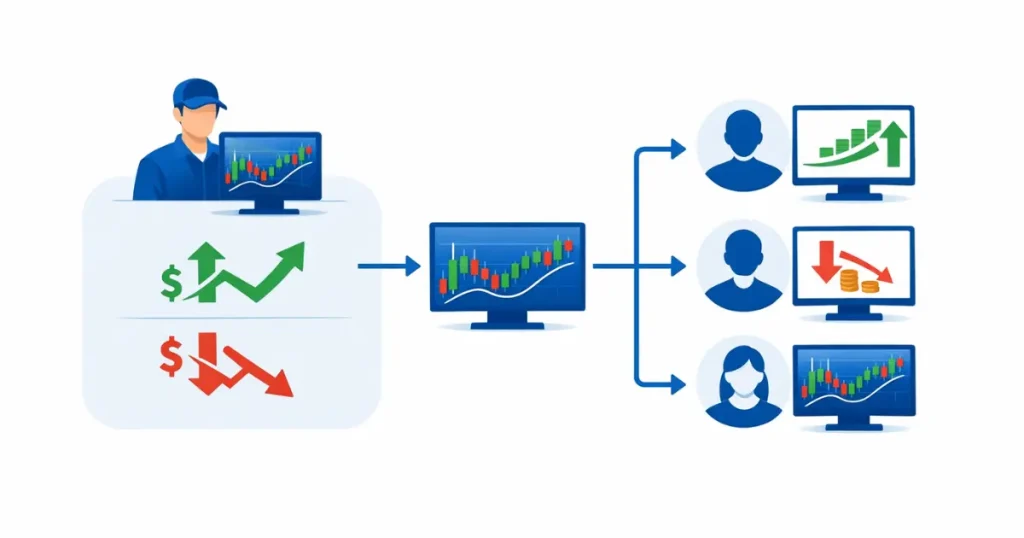
Copy trading is a trading arrangement with two roles: a provider, who places trades, and a follower, whose account automatically copies those trades. The follower does not usually send orders manually. Instead, the platform copies the provider’s signals into the follower’s account based on the selected allocation method.
The important point is that copy trading copies both sides of the result. If the provider gains, the follower may gain after fees and execution differences. If the provider loses, the follower also loses. Copy trading removes manual order entry, but it does not remove market risk.
| Role | What they do | What matters most |
|---|---|---|
| Provider | Trades their own strategy and allows others to copy it | Risk control, consistency, drawdown, strategy type |
| Follower | Allocates capital and copies the provider’s trades | Allocation size, stop limits, fees, provider selection |
| Broker/platform | Executes copied trades and records performance | Execution quality, spread, slippage, platform rules |
How Copy Trading Works
A copy trading platform links the follower account to the provider’s strategy. When the provider places an order, the platform creates a matching order in each follower account. The copied trade size is usually scaled by allocation, equity ratio, fixed lot settings, or another platform-specific rule.
- The provider opens or closes a trade.
- The platform sends a copy signal to linked follower accounts.
- The follower’s account opens a proportional position.
- Profit or loss is reflected in the follower account after spread, slippage, and fees.
Terminology varies by broker. You may see providers called signal providers, strategy managers, leaders, masters, or traders. The mechanism is similar: your account follows someone else’s trading decisions automatically.
Allocation Methods: How Your Trade Size Is Calculated
When your account copies a trade, the platform needs a rule to decide how large your position should be relative to the provider’s. The most common methods are:
- Proportional by equity: Your position size scales based on your equity relative to the provider’s equity. If the provider trades 1.0 lot with $10,000 equity and you have $1,000, your copied position is 0.1 lot.
- Fixed lot: You set a specific lot size for all copied trades regardless of the provider’s position size. This gives you full control over risk but may create mismatched drawdown expectations.
- Multiplier: You set a ratio (e.g., 2× or 0.5×) that scales the provider’s lot size up or down. Higher multipliers amplify both gains and losses.
Understanding your platform’s allocation method is essential because it directly determines how much you risk per trade and how much margin each copied position consumes.
Copy Trading vs Social Trading vs Mirror Trading
Copy trading, social trading, and mirror trading are often used interchangeably. Social trading usually emphasizes community, rankings, and trader profiles. Mirror trading often means automatically duplicating a strategy. Copy trading is the broader practical term most retail platforms use today.
How Money Flows in Copy Trading
In most copy trading setups, the follower’s money stays in their own trading account. The provider does not directly receive the follower’s deposit. Instead, the platform copies trades and calculates any performance fee when profitable results occur.
| Event | Follower result | Provider result | Broker/platform result |
|---|---|---|---|
| Winning trade | Receives trading profit minus fees | Receives own profit and possibly a performance fee | Earns spread, commission, or platform fees |
| Losing trade | Takes the copied trading loss | Takes their own trading loss | Still earns trading costs depending on pricing |
| Stop copying | May keep, close, or manually manage existing positions depending on settings | No direct control over follower account | Applies platform rules |
Performance fees can materially change your net return. A provider with a high gross return but a large fee may be less attractive than a steadier provider with lower fees and smaller drawdowns.
Is Copy Trading Profitable?
Copy trading can be profitable, but it is not profitable automatically. The provider must have a strategy that survives different market conditions, and the follower must use sensible allocation, stop limits, and fee awareness. A provider’s past return is only a starting point, not a prediction.
The biggest mistake is judging a provider only by return percentage. A strategy showing smooth gains may be using martingale, grid trading, oversized positions, or averaging down. These approaches can look stable for months and then lose a large portion of the account in one market shock.
Industry data from a 2026 multi-exchange study (Binance, Bybit, MEXC) covering 100,000+ copy trading outcomes found that roughly 48% of copy traders finished profitable in a 90-day period. However, only about 44% of providers generated positive returns for their followers — meaning many high-performing providers still left followers with net losses after fees and slippage. Long-term sustained profitability (6+ months) is estimated at 20–30% of traders.
| Good sign | Warning sign |
|---|---|
| Longer track record across different market conditions | Only a few weeks of strong returns |
| Controlled drawdown and clear risk limits | High win rate with occasional very large losses |
| Transparent instruments, lot size, and trade history | Hidden positions, unclear strategy, or edited or fake screenshots |
| Reasonable performance fee | High fee combined with high-risk trading |
Copy Trading Risks Beginners Should Understand
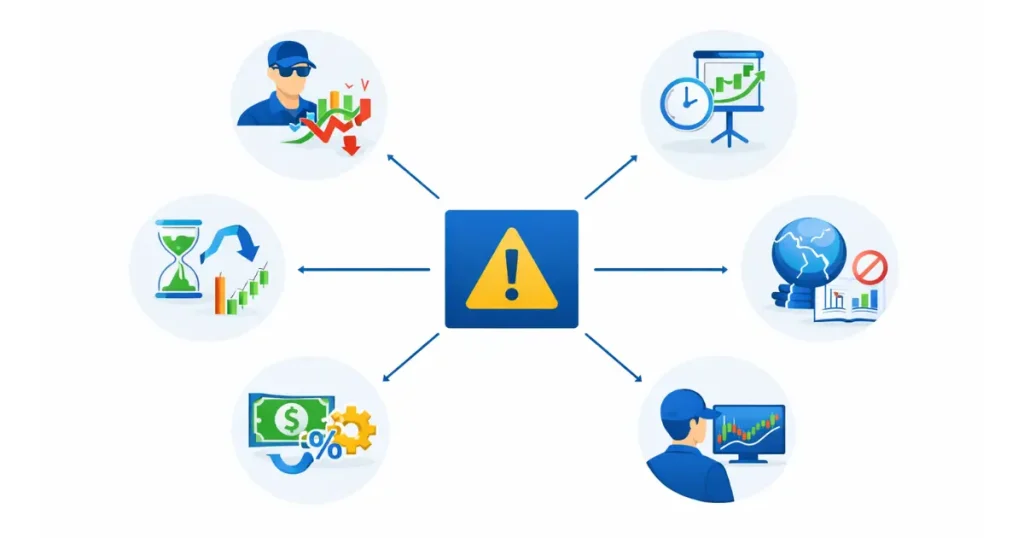
The main risk in copy trading is not the technology. The main risk is following the wrong trader with too much money. A copied strategy can lose quickly, especially in leveraged FX, gold, crypto, or index CFD markets.
- Past performance does not guarantee future results.
- High-win-rate strategies may hide large tail risk.
- Performance fees reduce actual follower returns.
- Slippage can make follower entries worse than provider entries.
- Followers can over-allocate to one provider and lose diversification.
- Some providers may stop trading responsibly after attracting followers.
For beginners, a practical rule is to treat every new provider as unproven. Start small, observe real-time behavior, set a maximum loss limit, and avoid increasing allocation only because the recent chart looks smooth.
Copy Trading Scams and Red Flags
Not every bad copy trading result is a scam. Markets are risky, and even honest providers lose money. A scam becomes more likely when performance is manipulated, risks are hidden, or the follower is pressured to deposit quickly. The key is distinguishing normal trading losses from deliberate deception.
| Red flag | Why it matters |
|---|---|
| Guaranteed monthly profit | Trading returns cannot be guaranteed. |
| Only screenshots, no verifiable history | Screenshots can be edited or selectively chosen. |
| No visible drawdown or losing periods | Real strategies have losses and volatility. |
| Pressure to deposit through a specific link immediately | The incentive may be affiliate commission, not your outcome. |
| Provider refuses to explain risk controls | You cannot evaluate what can go wrong. |
Common Beginner Mistakes in Copy Trading
Most beginners do not fail because they misunderstand the copy button. They fail because they copy too much, too fast, with too little understanding of risk. The first goal is not to find the highest-return provider. It is to avoid account-damaging mistakes.
- Following the top-ranked provider without checking drawdown.
- Allocating all capital to one strategy.
- Ignoring performance fees and spread costs.
- Assuming a high win rate means low risk.
- Increasing allocation after a short winning streak.
- Failing to set a maximum loss level for each provider.
How to Analyze a Copy Trading Provider
A provider should be analyzed like a risk profile, not like a popularity contest. Follower count, ranking position, and recent return are useful only after you understand the strategy behind them.
| Check | What to look for |
|---|---|
| Track record length | Prefer months of real history over a short spike in returns. |
| Maximum drawdown | Understand the worst historical decline and whether you could tolerate it. |
| Strategy type | Identify martingale, grid, scalping, news trading, swing, or discretionary methods. |
| Open trade behavior | Watch whether the provider holds losing positions, averages down, or hides risk. |
| Fees | Compare performance fee, spread, commission, and any subscription cost. |
| Instruments traded | Gold, crypto, indices, and exotic pairs may create faster drawdowns than major FX pairs. |
If you cannot explain how the provider makes money and how the provider loses money, you are not ready to allocate serious capital to that strategy.
If you already use a broker platform, compare provider records carefully with tools such as the XM copy trading analyzer before allocating real capital.
Copy Trading vs MAM/PAMM vs EA
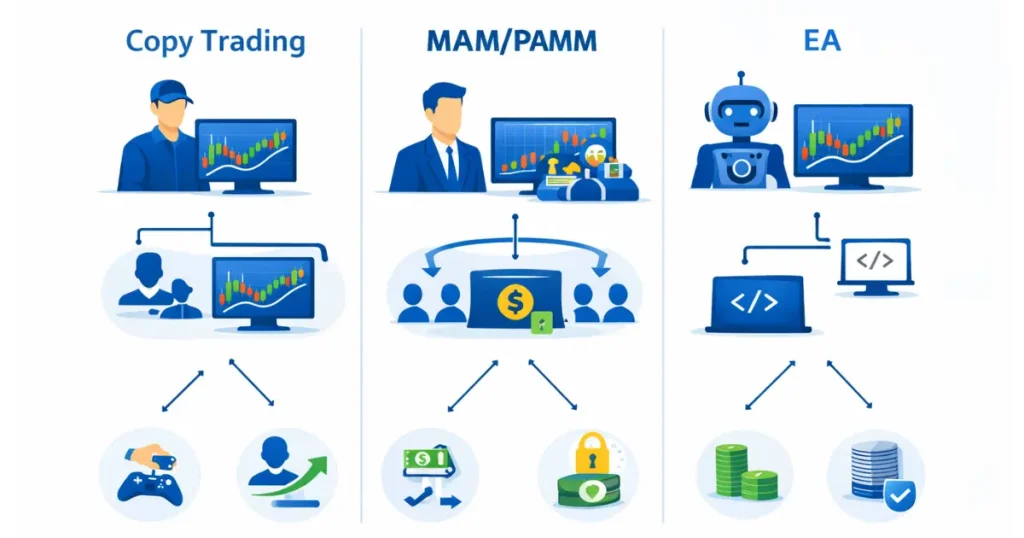
Copy trading, MAM/PAMM accounts, and Expert Advisors all create passive or semi-passive market exposure, but they are not the same product.
| Method | How it works | Main trade-off |
|---|---|---|
| Copy trading | Your account copies another trader’s orders while your funds stay in your own account | You control allocation, but provider selection is critical |
| MAM/PAMM | A manager trades across allocated or pooled investor funds | Less direct control and possible withdrawal restrictions |
| EA / automated trading | Software executes rules on your account | You need configuration, monitoring, and technical reliability |
The cleanest distinction is this: copy trading replicates trades, MAM/PAMM delegates management, and an EA runs code on your own account.
Who Copy Trading May Suit
Copy trading may suit people who want market exposure but do not want to manually trade every setup. It can also help beginners observe how experienced traders manage positions. It is less suitable for anyone who expects guaranteed income, ignores drawdown, or cannot tolerate losing streaks.
For English-language readers, availability and rules vary by country and broker entity. Do not assume an offshore copy trading platform is suitable, available, or properly regulated in your jurisdiction. Check local rules and platform terms before depositing funds.
How to Choose a Copy Trading Platform
Not all copy trading platforms are equal. The platform determines which providers are available, how trades are executed, what risk controls you have, and how fees are structured. Here are the key factors to compare:
| Factor | What to check |
|---|---|
| Regulation | Is the broker regulated by a recognized authority? Offshore entities may offer fewer protections. |
| Provider pool size | A larger provider catalog gives you more options, but quality matters more than quantity. |
| Risk management tools | Can you set stop-loss per provider? Limit maximum allocation? Pause copying? |
| Fee transparency | Are performance fees, spreads, and commissions clearly disclosed upfront? |
| Execution quality | How much slippage occurs between the provider’s fill and your copied fill? |
| Minimum deposit | Some platforms allow starting from $10–$50, others require $200+. |
For forex copy trading, platforms with cTrader Copy or XM’s built-in copy trading offer transparent statistics and reasonable fee structures. For crypto copy trading, Bybit’s copy trading platform and Bitget provide large provider pools with detailed performance history. Compare at least two or three platforms before committing funds.