



In March 2026, crude oil prices surged following tensions in the Strait of Hormuz. Such rapid market fluctuations present significant opportunities in crude oil CFDs. This article explains the fundamentals of trading crude oil CFDs, effective trading strategies, and recommended offshore brokers.
- The difference between WTI and Brent Crude
- How to choose between Spot and Futures CFDs
- Winning strategies for trading crude oil
- Recommended offshore brokers for crude oil trading
What is a Crude Oil CFD?
A crude oil CFD (Contract for Difference) allows you to profit from the price movements of oil without actually owning the physical commodity. Below, we break down the mechanics and unique characteristics of this instrument.
How Crude Oil CFDs Work
With CFDs, you don’t need to purchase or store barrels of oil. By utilizing leverage, you can control large positions with a relatively small margin. A major advantage over traditional stock investing is that you can enter the market from either side: buying (going long) or selling (going short), allowing you to profit even in a declining market.
Key Characteristics of Crude Oil CFDs
You can trade crude oil CFDs by opening an account with a forex and CFD broker. Here are the main characteristics:
- Nearly 24-hour trading on weekdays: You can enter trades matching the New York and London market sessions.
- Driven by unique catalysts: Prices respond to geopolitical risks, OPEC+ policy decisions, and inventory reports, rather than traditional corporate or general economic news.
- Excellent for portfolio diversification: Low correlation with stocks and currencies makes it a great asset for hedging.
Why the Author Focuses on Crude Oil CFDs
The author’s interest in trading crude oil CFDs stems from its relatively predictable long-term directional trends. Since oil is a resource that will eventually be replaced in the long run, it often experiences sustained downward trends, even though it spikes sharply in response to geopolitical tensions.
The Difference Between WTI and Brent Crude
Offshore forex and CFD brokers primarily offer two main types of crude oil instruments: WTI (OIL) and Brent (BRENT). While both serve as global pricing benchmarks, they are influenced by different production sources and market factors.
| Feature | WTI Crude | Brent Crude |
|---|---|---|
| Source | USA (e.g., Texas) | North Sea (UK, Norway) |
| Exchange | NYMEX (New York) | ICE (London) |
| Global Share | Primarily US Market | Approx. 65% of Global Trade |
| Middle East Risk Impact | Relatively Small | Significant |
| US Data Impact | Significant (e.g., Inventory) | Relatively Small |
| MT4 Symbol Example | OIL / USOil / CL-OIL | BRENT / UKOil / UKOUSD |
Because WTI is produced in the US, it reacts heavily to the weekly EIA crude oil inventory reports and US shale production trends. Conversely, Brent serves as the pricing benchmark for oil flowing from Europe, Africa, and the Middle East to Asia, acting as the standard for about 65% of globally traded oil.
Which one you choose depends on your trading style and the news you monitor. As a general rule: trade Brent if you’re focusing on Middle Eastern geopolitics, and trade WTI if you are watching US economic indicators.
Note: Dubai Crude, the benchmark for Middle Eastern oil, is rarely offered as a CFD, so we have omitted it from this guide.
Spot CFDs vs. Futures CFDs
Crude oil CFDs are categorized into Spot and Futures. While their prices track closely, their trading mechanisms differ. It’s crucial to understand these differences before trading.
| Feature | Spot CFD | Futures CFD |
|---|---|---|
| Expiration | None (Hold indefinitely) | Has a contract month (Auto-settles at expiry) |
| Swap Fees | Incurred daily | None |
| Spread | Tighter | Slightly wider |
| Best For | Day trading & Short-term | Medium-to-long term & Swap-avoidance |
Spot CFDs incur swap points (financing costs) every time you hold a position overnight. The longer you hold, the more the swap costs accumulate, making money management crucial for long-term positions.
Futures CFDs have an expiration date (contract month). When this date is reached, positions are automatically closed. For example, on XM, the symbol might look like “BRENT-MAR26”. If you want to maintain the position, you must close it before expiration and manually reopen it in the next contract month (a process known as rolling over).
Which is Recommended: Spot or Futures?
As long as you manage swap costs, Spot is generally more straightforward. You avoid the risk of accidentally hitting an expiration and getting forcibly closed out. Futures are mostly advantageous for ultra-long-term trades where rollover costs become a major factor. For standard swing trading or scaling-in (averaging down) strategies, Spot is usually preferred.
Two Winning Strategies for Crude Oil CFDs
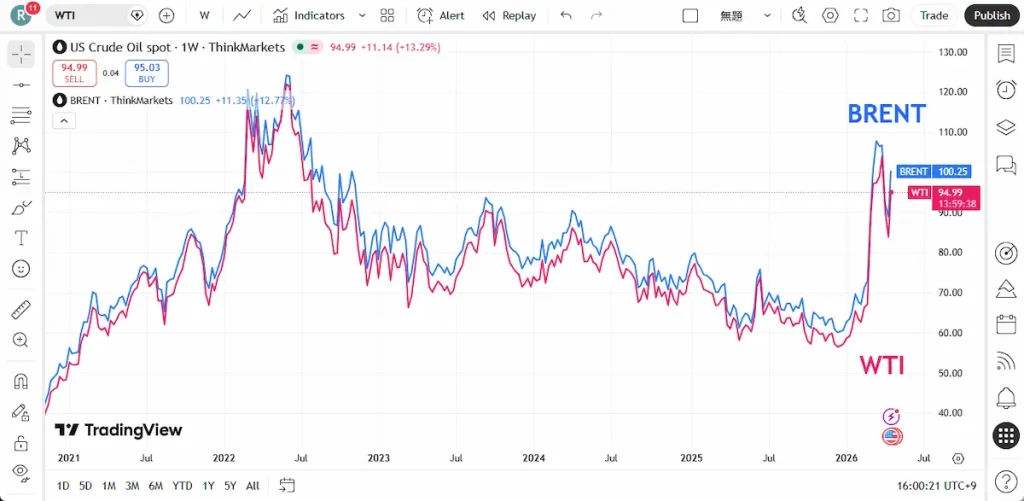
Like forex, you can profit in both directions with crude oil. Unlike stocks or currencies, oil is unique in that geopolitical events and producer policy decisions can trigger massive spikes or drops of tens of dollars. However, there is also a structural long-term downtrend due to the global energy transition. Therefore, both short-term buy strategies for spikes and short-selling strategies from peaks are highly effective.
1. Buy Strategy: Profit from Geopolitical Tensions & Rising Demand
This strategy involves taking a long position when factors align to push oil prices higher. Common catalysts include:
- Production cuts by OPEC+
- Rising geopolitical risks in the Middle East (supply fears)
- Surges in demand due to global economic recovery
- Sudden drops in US crude inventories
WTI and Brent react differently to the same news. Understanding these instrument characteristics is key to positioning yourself correctly.
| Catalyst | WTI | Brent |
|---|---|---|
| Strait of Hormuz / Suez Canal Risks | △ | ◎ |
| US Shale Production Policies | ◎ | △ |
| OPEC+ Production Cuts | ○ | ○ |
| US Inventory Reports (EIA) | ◎ | △ |
Many traders attempt to buy the moment news breaks, but often find the market has already surged. The initial move is almost always dominated by algorithmic trading. A more realistic approach for retail traders is buying the dip after the initial volatility subsides, or taking preemptive positions before scheduled announcements.
2. Sell Strategy (Shorting): Capitalizing on Post-Spike Reversals
Crude oil faces several structural, long-term headwinds:
- Global decarbonization initiatives
- Decreasing demand for transport fuels due to EV adoption
- Falling costs of solar and wind energy
During a crisis, a “fear premium” is priced into oil. Historically, this premium gradually fades as the conflict stabilizes or drags on without escalating. For example, during the Russia-Ukraine invasion in 2022, Brent surged past $130 but eventually trended back down to the $70 range over time.
While algorithms beat humans to the punch on breaking news buys, the slow unwinding of a price spike is a trend human traders can comfortably trade. For example, during tensions in the Strait of Hormuz when Brent exceeded $100, a strategy of scaling into short positions (short-selling with staggered entries) proved highly profitable once tensions eased and the price returned to the $80s.
Because no one knows exactly how high a geopolitical spike will go, maintaining robust margin levels is mandatory if you employ a scaling-in (averaging down) short strategy.
Top 3 Recommended Offshore Brokers for Trading Crude Oil CFDs
Here is a comparison of three major offshore brokers that provide excellent conditions for trading crude oil CFDs. Because heavily regulated domestic brokers frequently impose strict margin requirements and offer limited CFD options, international traders often prefer offshore brokers that provide higher leverage, negative balance protection, and promotional bonuses.
Choose the broker that best aligns with your trading style regarding leverage, swap fees, and available spot/futures instruments.
| Broker | WTI Ticker | Brent Ticker | Max Leverage | Spot/Futures |
|---|---|---|---|---|
| XM | OIL / OILMn | BRENT | Spot 200x Futures 66.6x | Both |
| HFM | USOil | UKOil | Spot 200x Futures 200x | Both |
| Exness | USOil | UKBrent | USOil 2000x | Spot Only |
XM: Trade Oil CFDs Using Generous Bonuses
XM allows you to trade both WTI and Brent, in both spot and futures contracts. Spot CFDs (OILCash / BRENTCash) offer up to 200x leverage, while Futures (OIL / BRENT) provide up to 66.6x leverage. Note that Spot CFDs on XM are exclusive to the MT5 platform.
A major advantage of XM is its bonus structure, allowing you to use account opening and deposit bonuses as additional margin for your crude oil trades.
HFM: Swap-Free Trading with High Leverage
HFM offers both WTI (USOil) and Brent (UKOil) in spot and futures formats, with leverage up to 200x for both.
Futures contracts inherently have no swap fees. Crucially, HFM’s Spot instruments (UKOIL.S / USOIL.S) offer a 45-day swap-free grace period, making it extremely cost-effective to hold positions across multiple days or weeks.
While you can use deposit bonuses on their Top-up Bonus accounts, note that these specific bonus accounts do not qualify for swap-free conditions.
Exness: 2000x Leverage and Tight Spreads
Exness offers WTI (USOil) and Brent (UKBrent) exclusively as Spot CFDs. Their standout feature is an incredible maximum leverage of 2000x. This straightforward, spot-only setup is perfect for traders who want simplicity.
While Exness does not offer promotional bonuses, they compensate by offering tighter spreads than most competitors. For high-frequency traders, the reduced trading costs make Exness the superior choice.
Furthermore, WTI (USOil) on Exness is swap-free. You won’t incur overnight financing charges, making it highly suitable for medium-term strategies like short-scaling.
Important Risks in Crude Oil CFD Trading
While crude oil CFDs offer massive profit potential due to high volatility, poor risk management can quickly wipe out an account. Be aware of the following risks before you start.
Wider Spreads Than Forex
The spread on crude oil CFDs is generally wider than standard fiat currency pairs. During low liquidity hours or volatile geopolitical events, spreads can widen further. Therefore, oil is not ideal for rapid-fire scalping, but rather suits swing trading and medium-term holdings.
Beware of Instant Liquidations with High Leverage
Oil can move several dollars to tens of dollars rapidly on breaking news. Over-leveraging leaves no room for these violent whipsaws and can trigger an immediate stop-out (liquidation). Always restrict your position size to a safe percentage of your equity and calculate your required margin beforehand.
Pre-Plan Your Stop-Loss for Short Trades
While scaling into a short position during a crisis spike is a proven strategy, an unexpected escalation could push prices to unforeseen highs. If you scale in, you must calculate in advance how much floating loss you can endure. Set a hard stop-loss level first, and reverse-engineer your position sizing based on your available equity.
Swap Costs on Spot CFDs
Spot CFDs accrue swap fees for every night you hold them. In some cases, both long and short swaps can be negative. Over weeks or months, these fees will eat into your profits. If you plan to hold a position for an extended period, confirm the broker’s current swap rates beforehand or use a swap-free account.