



Averaging down in forex can look brilliant right before it destroys an account. That is why traders talk about it in extremes: some call it powerful because it improves the average entry price, while others call it reckless because it can turn one bad idea into a margin problem.
This guide explains both sides clearly. You will learn what averaging down is, why traders think it works, why it blows up so many accounts, when it may be defensible, and why it is not the same thing as dollar-cost averaging.
- How averaging down changes your average entry price
- Why short-term win rate can look better even when risk gets worse
- The 5 reasons averaging down becomes dangerous in real trading
- How averaging down differs from disciplined long-term investing
What Is Averaging Down in Forex?
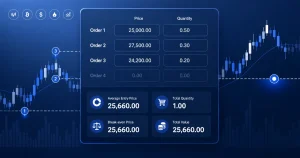
Averaging down means adding another position in the same direction after the market has moved against your original trade. The goal is simple: lower the average entry price so a smaller rebound can get you back to breakeven or profit.
For example, if you buy USD/JPY at 150 and price falls to 148, buying again at 148 lowers the average entry. That can make a partial recovery look easier. But the trade-off is equally important: your total exposure is now larger while the market is still moving against you.
Why Traders Think Averaging Down Is Powerful
Reason 1: You Need Less of a Rebound to Recover
The biggest attraction is mathematics. Once the average entry improves, the market does not need to return all the way to the first entry for the position to recover. That feels efficient and, in a range-bound market, can work surprisingly often.
Reason 2: Short-Term Win Rate Often Looks Better
Because markets do retrace, averaging down can create many small “rescues.” That is why traders using it often post high win rates. The problem is that win rate alone says nothing about the size of the eventual loss when the rescue never comes.
Reason 3: Professionals Sometimes Scale Into Positions Too
Experienced traders do sometimes build positions in stages. But that is not the same as emotionally rescuing a losing trade. A professional scale-in is usually planned before entry, tied to a defined market structure, capped by total size, and paired with a clear invalidation level.
Why Averaging Down Is Dangerous
Danger 1: Trends Can Keep Going Longer Than You Think
Averaging down works best in mean-reversion. It breaks down in strong trends. Once the market keeps moving one way, each additional entry increases your exposure to the exact condition your original trade misunderstood.
This is especially dangerous in fast markets. If you have seen how destructive that becomes in high-volatility products, read our gold trading risk guide for a related example.
Danger 2: Margin Pressure Accelerates
Every added position raises total size, required margin, and potential loss at the same time. That creates a nasty double effect: floating loss grows while account flexibility shrinks. What looked manageable on the first entry can become urgent on the third.
Danger 3: Your Stop-Loss Logic Usually Gets Weaker
Many traders start with a stop-loss, then quietly replace the stop with another add-on order. That changes the role of averaging down from “planned scale-in” to “avoid realizing the loss.” Once that happens, the trade no longer has a clean risk definition.
Danger 4: Biases Take Over Your Decision-Making
Averaging down is emotionally seductive because it makes you feel active and in control. In practice, it often reflects sunk-cost bias, confirmation bias, and overconfidence. You stop asking whether the original thesis is still valid and start asking how to avoid admitting the loss.
Danger 5: One Big Loss Can Erase Many Small Wins
This is the real structural problem. Averaging down often creates a payoff profile of many small wins and one catastrophic loss. That means a strategy can feel successful for months while silently building the conditions for a very bad day.
When Averaging Down May Be Defensible
For most beginners, the honest answer is simple: do not use averaging down as a rescue technique. Still, there are limited cases where staged entries can be rational. Those cases demand structure, not hope.
- The market is clearly range-bound or mean-reverting, not trending hard
- The maximum number of adds is fixed before the first entry
- The total position size is capped in advance
- The final stop-loss is defined before the trade starts
- The account can tolerate the full planned loss without emotional panic
Important: more available leverage does not make averaging down safer. It may delay liquidation, but it also makes it easier to build oversized exposure. More room to add is not the same as a sound strategy.
Averaging Down vs. Dollar-Cost Averaging
Many traders confuse averaging down with long-term investing, but they are not the same. Averaging down is a reactive decision inside an already losing trade. Dollar-cost averaging is a planned investment process that adds fresh money at regular intervals regardless of short-term price.
The SEC’s investor education site explains that dollar-cost averaging means investing equal amounts at regular intervals over time. That is fundamentally different from adding leverage to an open losing forex position.
| Method | When you add | Why you add | Typical use |
|---|---|---|---|
| Averaging down | After the trade moves against you | Lower the average entry price | Short-term trading or tactical scale-ins |
| Dollar-cost averaging | At fixed time intervals | Build a long-term position consistently | Long-term investing, not leveraged rescue trades |
Bottom Line: Averaging Down Is a Tool, Not an Excuse
Averaging down can improve an average entry price. That part is true. The dangerous part is what traders often do next: use that fact to justify ignoring trend, margin, and invalidation.
If you are a beginner, the safer default is to learn one-entry risk management first. Add complexity later, only when your size, exits, and market context are preplanned rather than emotional.
For more practical risk-management articles, explore COPI.
FAQ: Averaging Down in Forex
These are the questions traders usually ask after they realize lowering the average entry price does not automatically lower the risk.