




Bybit’s copy trading ecosystem offers three distinct services: Classic, Pro, and TradFi. Each caters to different investment styles and experience levels. In this guide, we compare these three Bybit copy trading modes from a follower’s perspective to help you choose the best fit for your portfolio.
- Core differences between Classic, Pro, and TradFi
- Detailed comparison of investment terms, fees, and transparency
- What information you can see on each platform’s interface
- How to choose the right service based on your trading style
For a step-by-step tutorial on how to start copy trading on Bybit, check out our dedicated guide below:
Understanding Bybit Copy Trading: Classic vs. Pro vs. TradFi
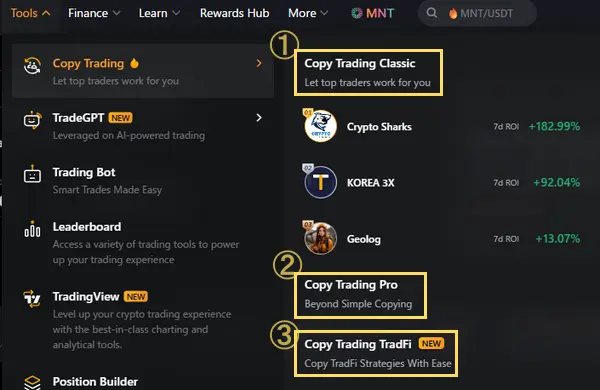
- Classic: Beginner-friendly service for copying individual crypto trades.
- Pro: Advanced mutual-fund-style investment in professional crypto strategies.
- TradFi: Traditional finance copy trading (Gold, Forex, CFDs) for experienced FX traders.
The primary differences between these modes lie in how investments are managed and what assets are traded.
Classic and TradFi operate on a traditional copy trading model where you mirror individual trade signals. In contrast, Pro functions more like a mutual fund or PAMM account—you purchase a “share” of a strategy and let the Master Trader manage the overall fund.
Additionally, the supported assets differ. Classic focuses exclusively on cryptocurrencies (BTC, ETH, SOL) via USDT Perpetual contracts and trading bots. Meanwhile, TradFi lets you copy trades on Gold, Forex, and stock indices using an MT5 environment.
| Feature | Classic | Pro | TradFi |
|---|---|---|---|
| Investment Method | Direct trade copying | Fund share purchase | Direct trade copying |
| Traded Assets | Cryptocurrency | Cryptocurrency | Gold, Forex, CFDs |
| Mechanism | Mirrors individual orders | Invests in a pooled strategy | Mirrors individual orders via MT5 |
| Transparency | Full trade history visible | Trades hidden (NAV only) | Full trade history visible |
- Master Trader: The experienced trader providing signals or managing the strategy.
- Follower: The investor who copies the Master Trader or buys into their strategy.
- Profit Sharing: The percentage of profits deducted and paid to the Master Trader as a performance fee.
Bybit Copy Trading Detailed Comparison
Let’s dive deeper into the specific conditions, fees, and requirements for each of the three platforms.
Basic Trading Conditions
| Metric | Classic | Pro | TradFi |
|---|---|---|---|
| Assets | Crypto (USDT Perps) | Crypto (Spot & Futures) | Gold, Forex, CFDs |
| Trading Type | Manual trades, Grid Bots | Fund management | Manual trades, MT5 EAs |
| Minimum Investment | 50 USDT | 500 USDT | 100 USDT |
| Leverage Control | Follow Master or Custom | Managed by Master | Follows Master (up to 500x) |
Minimum Investment Requirements
The baseline entry differs: Classic starts at 50 USDT, TradFi at 100 USDT, and Pro at 500 USDT. However, Master Traders can manually increase the minimum requirement. If a top-performing Master sets a 1,000 USDT minimum, you must meet that threshold to follow them.
Classic Mode: Smart Copy vs. Advanced Copy
Classic mode offers two distinct ways to follow, giving you control over leverage and margin.
- Automatically matches the Master Trader’s leverage.
- Followers cannot adjust leverage manually.
- Position sizing is calculated automatically based on your balance ratio.
- Allows followers to set custom leverage for different trading pairs.
- Fixed margin per order can be specified.
- Offers better risk management, but requires trading knowledge.
Available Master Traders
| Platform | Classic | Pro | TradFi |
|---|---|---|---|
| Estimated Providers | ~13,110 | ~20 | ~16,770 |
TradFi currently has the largest pool of Master Traders, followed closely by Classic. Bybit Pro is highly exclusive, featuring only a handful of strictly vetted institutional-grade managers.
Transparency and History
| Trade Visibility | Fully Public (Real-time) | Private Strategy | Fully Public (Real-time) |
|---|---|---|---|
| History Logs | Detailed entry/exit data | NAV updates only | Detailed entry/exit data |
| Follower Stats | Individual PnL shown | Not displayed | Individual PnL shown |
Both Classic and TradFi allow you to see every open position and historical trade of a Master Trader. This transparency lets you verify their strategy (e.g., checking if they use high-risk Martingale methods). Pro, on the other hand, hides the strategy to protect the manager’s intellectual property; you can only evaluate performance through the Net Asset Value (NAV) chart.
Profit Sharing and Trading Fees
| Cost Type | Classic | Pro | TradFi |
|---|---|---|---|
| Profit Share | 10% – 15% (Tier-based) | Custom (e.g., 20%) | Up to 15% (HWM)* |
| Trading Fees | Standard Crypto Fees | Standard Crypto Fees | Spread & Swaps |
*HWM = High-Water Mark (Profit share is only paid on new peak equity levels).
If you generate profits through copy trading, a percentage is shared with the Master Trader. In Classic, the rate is fixed between 10% and 15% depending on the Master’s VIP tier. In Pro and TradFi, the Master sets their own rate.
You also pay normal trading fees based on the asset. Classic and Pro incur crypto maker/taker fees and funding rates, while TradFi is subject to forex spreads and overnight swaps.
Bybit Classic: Interface and Features
Classic is the standard crypto copy trading platform. Because all trade logs are public, it’s easier to assess risk.
Master Trader Discovery Leaderboard
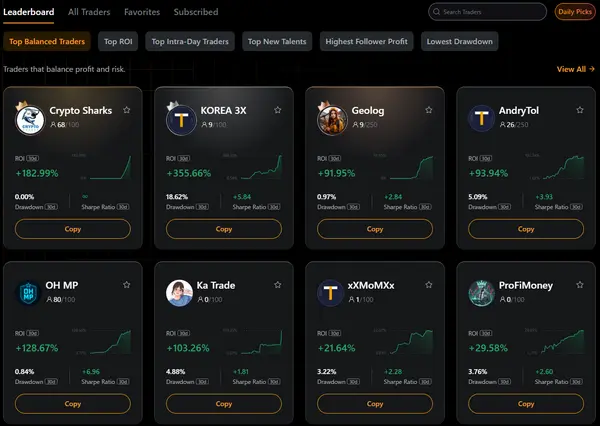
The dashboard ranks Master Traders by ROI, win rate, and follower profit. You can filter by strategy type or asset to find a trader that matches your goals.
Detailed Strategy Analysis
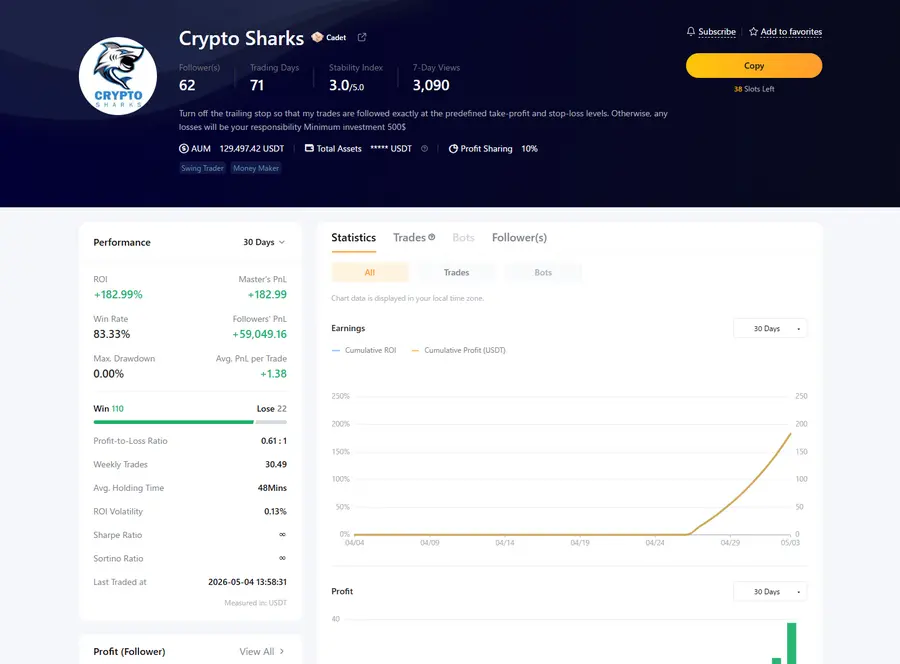
Clicking on a profile reveals their entire trade history. You can inspect their entry prices, leverage used, current floating PnL (open positions), and maximum drawdown. This data is critical for spotting reckless trading habits.
Bybit Pro: Interface and Features
Pro is built for high-net-worth investors seeking institutional-grade crypto management. Strategies are strictly vetted by Bybit.
Fund Dashboard
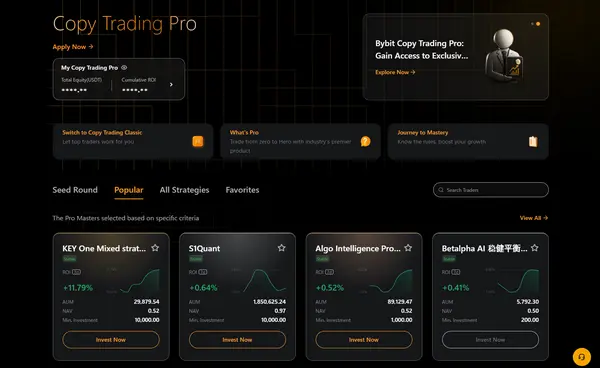
Instead of individual traders, you’ll see “Strategies” listed with their Net Asset Value (NAV), total Assets Under Management (AUM), and historical ROI charts.
Strategy Performance
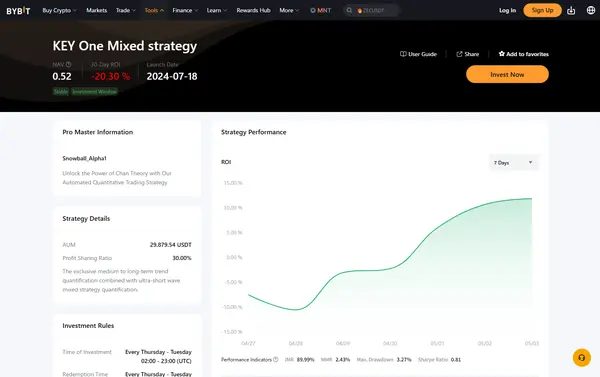
The detail page focuses entirely on the fund’s growth curve over time. Because the underlying assets and trades are hidden, your investment decision relies heavily on the manager’s NAV consistency and drawdown control.
Bybit TradFi: Interface and Features
TradFi brings standard MetaTrader 5 (MT5) functionality to Bybit, allowing you to copy Forex, Gold, and Indices trades. It’s highly favored by users migrating from traditional forex brokers.
TradFi Provider List
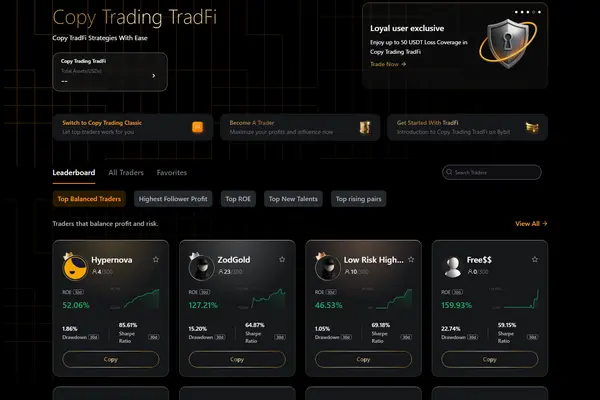
Similar to Classic, the TradFi leaderboard displays ROI, follower count, and win rate. Since forex markets operate differently than crypto, you’ll often see strategies specializing solely in Gold (XAUUSD) or major FX pairs.
MT5 Trade Verification
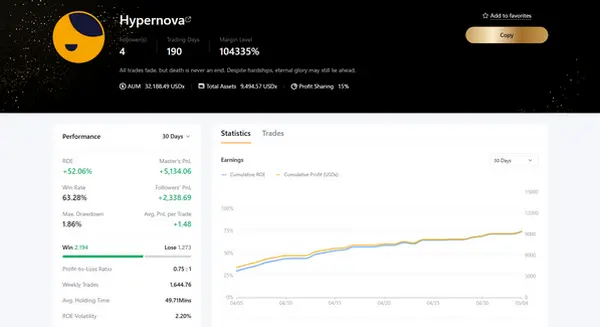
TradFi profiles show precise MT5 trade data, including lot sizes, pip gains/losses, and swap costs. This is invaluable for forex traders looking to analyze the Master’s risk management in traditional markets.
Important Risks and Considerations
- No Guarantees: Past performance is never an indicator of future results. Any Master Trader can experience a losing streak, putting your capital at risk.
- Active Monitoring Required: “Set and forget” is dangerous. You must routinely check open positions, floating losses, and overall market conditions.
- Profit Share Mechanics: The performance fee is automatically deducted when a profitable trade is closed. If a Master Trader makes a profit but later loses money, previously deducted fees for closed winning trades are generally not refunded (though TradFi uses a High-Water Mark to mitigate this).