




Is copy trading profitable? The short answer is yes — but only if you understand how the system actually works. Over 2.5 months of copy trading on Exness, my $2,500 account grew to $3,044, a gain of +$544 (~22%). That result didn’t come from luck — it came from following a few specific rules that most beginners skip entirely.
The catch is that copy trading without a risk framework isn’t investing — it’s handing your money to someone else with no safety net. The most common story in copy trading goes like this: two weeks of steady gains, then one overnight event wipes out everything and more. This article explains exactly why that happens and how to avoid it.
Below you’ll find real trade data from 80+ copy trades, the three rules I follow to stay profitable, and answers to the most common questions beginners ask before getting started.
Is Copy Trading Profitable? Yes — If You Respect the Blowup Risk
As I mentioned above, copy trading is absolutely profitable — in my experience, more accessible than trading on your own, and with the right provider you can realistically target 1% daily returns. But starting without understanding why it works means you will almost certainly lose money eventually.
Let me explain the structural reason copy trading generates consistent returns — and the hidden risk that’s baked into that structure.
Why Daily 1% Returns Are Achievable
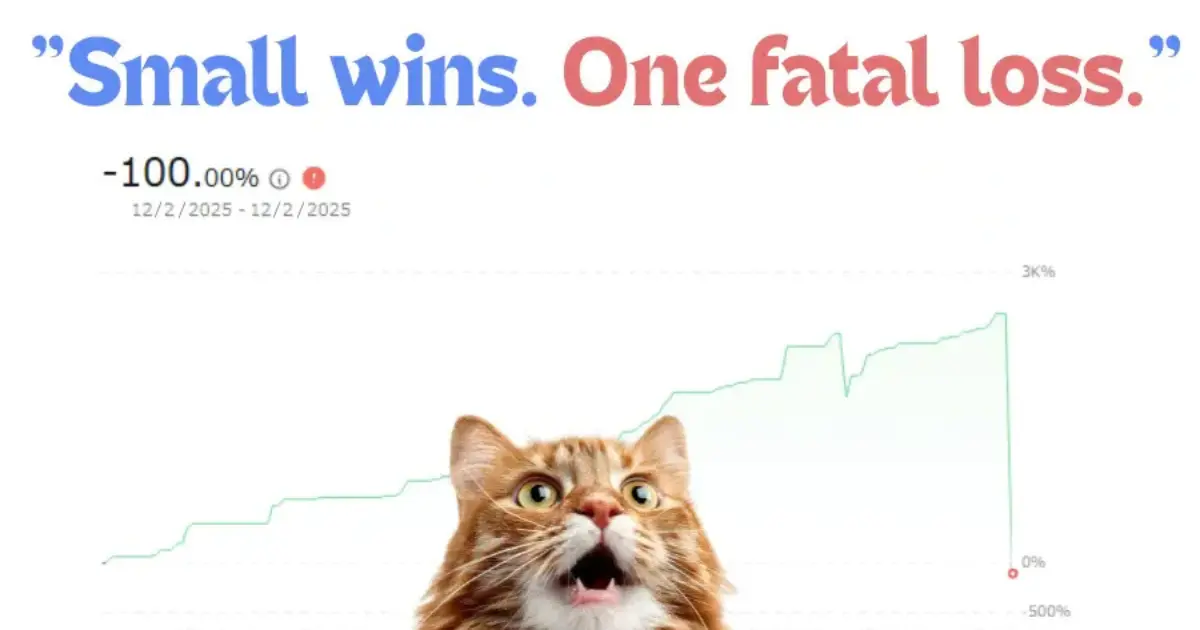
Most popular copy trading providers use a martingale averaging strategy — sometimes called “grid-down” or “averaging down.” When price moves against an open position, the strategy adds more positions and increases the lot size, effectively doubling down to recover faster. This produces high win rates and a chart that looks like a smooth, consistent uptrend.
The psychology behind this matters. Followers (the people copying trades) want stability — they want to see their balance grow every day. Providers who use volatile, high-risk-reward strategies (cut losses fast, let winners run) can go 10 trades without a win, which causes followers to abandon them. So the copy trading ecosystem naturally selects for high-win-rate, consistency-first strategies — and martingale fits that profile perfectly.
The Martingale Blowup: The Risk You Must Plan For
Martingale averaging has one fatal flaw: when price moves sharply and steadily in one direction, the stacked positions blow up the account. It doesn’t matter how many weeks of steady gains came before — a single high-volatility event (a major economic release, a central bank decision, or a geopolitical shock) can wipe out months of profit and blow the account entirely.
So is copy trading profitable? More precisely: copy trading is profitable right up until the account blows up. The question isn’t whether it will blow up — martingale accounts always do eventually. The question is whether you’ve structured your investments so that you’re profitable even after the blowup happens.
That’s exactly what the next section covers: how I built a system where blowups are expected and planned for — and the math still works in my favor.
Real Copy Trading Results: 2.5 Months of Live Data
Here’s what actually happened when I put this into practice on Exness over 2.5 months (late November 2025 to mid-February 2026), following 80+ providers.
My Approach to Selecting and Managing Providers
- Start every new provider at $10–$50 to test performance before committing more capital
- Scale up gradually to $100, $200, $400… only if the provider shows consistent results
- Check P&L daily — if profitable, raise the stop-loss to lock in gains
- When the stop-loss is hit, exit and evaluate carefully before re-following
My total available margin was $2,500, but I enforced a strict rule: start every provider at the minimum ($10–$50), regardless of how impressive their track record looks.
Overall Performance
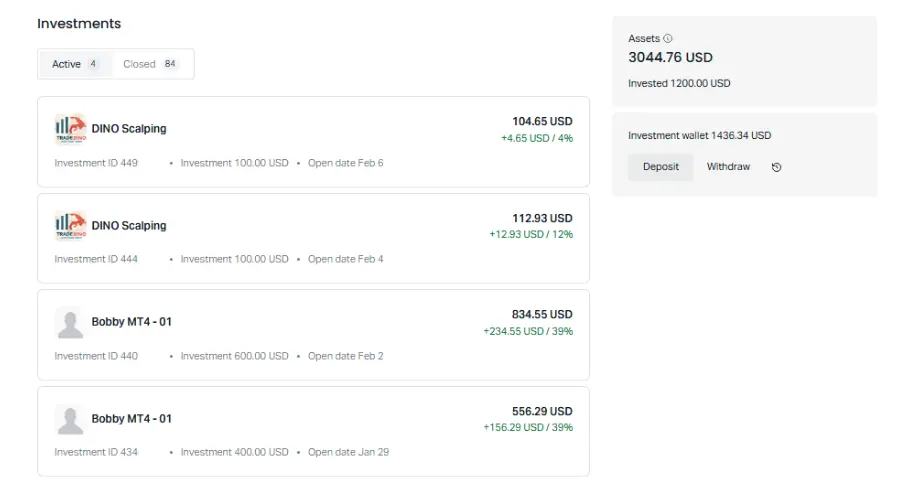
The first month was rough — lots of failed experiments, slow growth. But after finding two reliable providers and refining my process, the results improved significantly. Here’s the summary:
- Period: ~2.5 months
- Starting capital: $2,500 (started at $50, scaled to $1,200 active allocation)
- Net profit: +$544 (account grew to $3,044)
Full Provider Results
Here’s a breakdown of every provider I followed, their strategy, and the outcome:
| Provider | Strategy Notes | P&L | Status |
|---|---|---|---|
| Bobby MT4-01 | Skilled martingale trader with 0% performance fee. Strong entry/exit discipline. I’m using a -20% stop-loss and continuing to follow — expecting eventual blowup but total P&L is still very positive. | +$586 | Still following |
| DINO Scalping | High-frequency scalper generating ~10% weekly gains. Risk of eventual blowup is high, so allocation kept modest. 25% performance fee is on the high side. | +$151 | Still following |
| Uzzi Gold Scalp | Scalping strategy with frequent trades and initially fast gains — then a sharp drawdown wiped out all open profit. | +$9 | Stop-loss hit |
| Calculus Trading | Conservative approach, high margin ratio — but a sudden Gold (XAU/USD) spike triggered the stop at -17%. Re-entered, blew up again. | -$53 | Stop-loss hit |
| Ds Steady Growth | Lost 50% the day after I scaled up my allocation. Bad timing. | -$57 | Exited |
| Others | Various providers tested and abandoned quickly after poor early results. | -$92 | Exited |
Of all the providers I’ve tried, only Bobby MT4-01 and DINO Scalping remain. Even if both eventually blow up, my current total P&L means I finish positive. That’s the goal.
Platform update: Exness has officially announced a full phase-out of its copy trading service by June 25, 2026 (no new strategies from February 16, 2026; all positions auto-closed June 25, 2026). If you are currently using Exness for copy trading, plan your migration to an alternative platform such as XM or other supported brokers.
3 Rules That Keep Copy Trading Profitable
Here are the three rules I follow without exception. These are the difference between copy trading that works and copy trading that destroys accounts.
Rule 1: Always Set a Stop-Loss
This is non-negotiable. Every martingale-based provider will blow up. Not “might” — will. A stop-loss is what transforms a catastrophic blowup into a planned, limited loss that your overall strategy can absorb.
I typically set stop-losses between 10% and 20%. Lower stops mean smaller maximum losses per blowup, but also risk premature triggering during normal drawdowns — which wastes capital on unnecessary exits. Too low and the stop fires before the strategy has a chance to recover; too high and you expose yourself to severe damage.
Check the provider’s description — many recommend a specific stop-loss range. If no recommendation is listed, start at 20% and track the provider’s daily margin levels to calibrate over time. You can also reference the provider’s historical max drawdown as a reference point.
Rule 2: Target Providers with 20% or Lower Performance Fees
If a martingale provider takes 30% of every profitable trade before the blowup comes, your actual take-home may be negative after the account is wiped. Performance fees compound the math against you.
Lowering performance fees is one of the highest-leverage improvements you can make to copy trading profitability — it doesn’t require better market reading, just better provider selection.
Bobby MT4-01, my best performer, charges 0% — every dollar of profit stays in my account. Calculus Trading charged 10%. DINO Scalping charges 25%, which is why I keep my allocation there modest. The math is clear: the lower the fee, the more blowups you can absorb and still stay net positive.
Rule 3: Pause During Volatile Market Conditions
The majority of copy trading providers trade Gold (XAU/USD), and most use martingale or averaging strategies. These strategies thrive in ranging, low-volatility markets — and fail spectacularly during trending, high-volatility conditions.
Martingale and trending markets are a dangerous combination. Calculus Trading’s blowup happened during a period of sharp Gold movement — a predictable outcome in hindsight. When Gold or your provider’s primary pair is experiencing strong directional momentum or elevated volatility (major economic releases, geopolitical news), consider pausing your copy.
Copy trading platforms let you start and stop following at any time. You don’t have to stay exposed through every market condition — that’s one of the advantages copy trading has over traditional investing. Use it.
Copy Trading FAQ
Note: This article covers copy trading through regulated FX broker platforms (such as Exness, XM, and cTrader Copy). Copy trading solicited via social media, Telegram, or WhatsApp groups is a common fraud vector — approach those with extreme caution.