




Copy trading scams have become increasingly sophisticated, targeting beginners who want to profit from financial markets without extensive trading experience. While legitimate copy trading platforms allow you to automatically replicate professional traders’ strategies, scammers exploit this system to steal funds from unsuspecting investors.
In this comprehensive guide, you’ll learn the three most common copy trading scam patterns that trap beginners, how to identify them, and actionable steps to protect your investment.
What is a Copy Trading Scam?
A copy trading scam is a fraudulent scheme where bad actors manipulate social trading platforms, fake performance records, or misrepresent investment products to deceive investors. Victims often lose their entire investment believing they’re following a successful trader or legitimate system.
According to the Commodity Futures Trading Commission (CFTC) and National Futures Association (NFA), forex and trading-related fraud has increased significantly in recent years, with social trading platforms becoming a common vector for scams.
Scam Pattern #1: Hidden Loss Manipulation (Unrealized Loss Hiding)
The first and most deceptive copy trading scam involves hiding unrealized losses to inflate apparent win rates. This technique creates an illusion of consistent profitability while the actual account may be deeply underwater.
How Hidden Loss Scams Work
Scam traders use a systematic approach to manipulate their performance statistics:
When trades show profit:
- Small gains are immediately closed and locked in
- Multiple small wins of 10-20 pips accumulate over time
- The equity curve appears to grow steadily
- Win rate statistics look impressive (80-90% or higher)
When trades show loss:
- Losing positions are kept open indefinitely (a practice called “bag holding”)
- Losses remain unrealized and invisible in closed trade history
- The trader waits for the market to potentially recover
- Open losing positions don’t affect reported win rates
This creates a misleading performance record where closed trades show excellent statistics while the account actually carries massive unrealized losses.
The Inevitable Crash: When Hidden Losses Explode
Eventually, accumulated hidden losses reach a critical point where the margin level falls below the broker’s requirement. This triggers one of two catastrophic outcomes:
- Forced liquidation (margin call): The broker automatically closes all positions at once, realizing massive losses instantly
- Desperate loss-cutting: The trader finally closes positions to prevent margin call, causing sudden equity drop
In both scenarios, followers who were impressed by the fake win rate suddenly see their accounts wiped out.
How to Detect Hidden Loss Manipulation
The only reliable way to identify this copy trading scam is to examine unrealized (floating) profits and losses:
- Check current open positions: Are there large unrealized losses being carried?
- Look for old losing trades: Positions held for weeks or months at a loss are red flags
- Compare equity vs. balance: A large gap indicates hidden losses
- Analyze drawdown history: Consistent equity growth without drawdowns is suspicious
- Review position duration: Professional traders rarely hold losing positions for extended periods
Legitimate traders manage risk actively and close losing positions according to their strategy—not hide them hoping for recovery.
Scam Pattern #2: Fake Reviews and Artificial Popularity
The second major copy trading scam involves manufacturing fake social proof. In the age of social media, scammers have developed sophisticated methods to create the illusion of widespread success and satisfied customers.
Organized Fake Review Operations
Scam operations typically employ these tactics:
- Mass fake account creation: Hundreds of fake profiles posting enthusiastic testimonials
- Coordinated engagement: Group members systematically like, share, and comment to boost visibility
- Manufactured urgency: “Limited spots available” or “Offer expires today” pressure tactics
- Staged testimonials: Video testimonials from actors claiming massive profits
False Authority and Credibility Signals
To appear legitimate, scammers often:
- Display photos of luxury cars, homes, and lifestyles claimed to come from trading profits
- Fabricate endorsements from celebrities or financial influencers
- Create fake news articles suggesting mainstream media coverage
- Claim registration with regulatory bodies they’re not actually registered with
- Use professional-looking websites and marketing materials
The SEC and CFTC have issued multiple warnings about fraudsters using these exact tactics to promote fraudulent investment schemes.
Protection Strategy: Trust Only Verifiable Data
To protect yourself from fake review scams:
- Ignore all testimonials and reviews — Assume they’re fabricated unless you can independently verify them
- Reject unsolicited investment offers — Legitimate professionals don’t cold-contact strangers on social media
- Verify regulatory registration — Check CFTC, NFA, or SEC databases for registered entities
- Analyze raw trading data only — Focus on verified performance metrics, not marketing claims
- Be skeptical of urgency — “Act now” pressure is a classic manipulation tactic
Scam Pattern #3: MAM/PAMM Disguised as Copy Trading
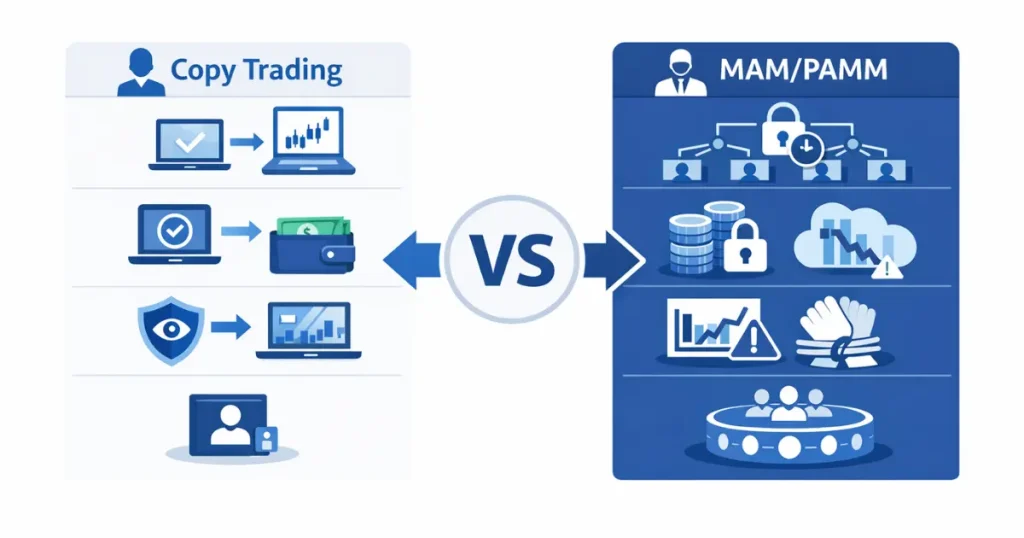
The third copy trading scam is particularly dangerous because it involves a fundamental misrepresentation of the investment product. Scammers claim to offer copy trading but actually enroll victims in MAM (Multi-Account Manager) or PAMM (Percentage Allocation Management Module) arrangements.
Critical Difference: Copy Trading vs. MAM/PAMM
Understanding the difference is essential for protecting yourself:
| Copy Trading | MAM/PAMM | |
|---|---|---|
| How It Works | Trading signals are copied to your account automatically | Money manager trades your account on your behalf |
| Stop Trading | Anytime—you control your account | Often restricted during contract period |
| Withdraw Funds | Anytime without restrictions | May be locked for months (lock-up period) |
| Fund Location | Your own broker account | PAMM: Pooled account; MAM: Your account but managed |
| Trading Transparency | Full visibility of all trades | PAMM: Limited transparency; MAM: Varies |
| Emergency Control | You can close positions anytime | May not be able to intervene |
Why This Scam Is So Dangerous
When you’re enrolled in MAM/PAMM under false pretenses:
You cannot stop trading:
- Requests to stop are denied due to “open positions affecting margin”
- The excuse is actually a tactic to prevent you from withdrawing
- You watch helplessly as your account loses value
You cannot withdraw funds:
- Withdrawals restricted to monthly or quarterly windows
- Lock-up periods may extend for months or years
- Even profits may be inaccessible
You cannot respond to emergencies:
- Market crashes—you can’t close positions
- Trader disappears—no one responds to communications
- Your own money is completely out of your control
Protection Strategy: Verify Account Control Before Investing
Before committing any funds, confirm these critical points:
Account Control Verification:
- Can you stop copying trades instantly at any time?
- Can you withdraw all funds immediately without restrictions?
- Can you close positions yourself in an emergency?
- Is the registered email address yours (not the trader’s)?
- Do you have full login credentials to your own account?
Contract Terms to Review:
- Are there any lock-up periods? (Red flag if yes)
- What are the withdrawal restrictions?
- How are fees calculated and charged?
- What is the termination process?
- Is everything clearly documented in writing?
If any answer suggests you won’t have full control over your funds, walk away immediately.
Real Copy Trading Scam Examples
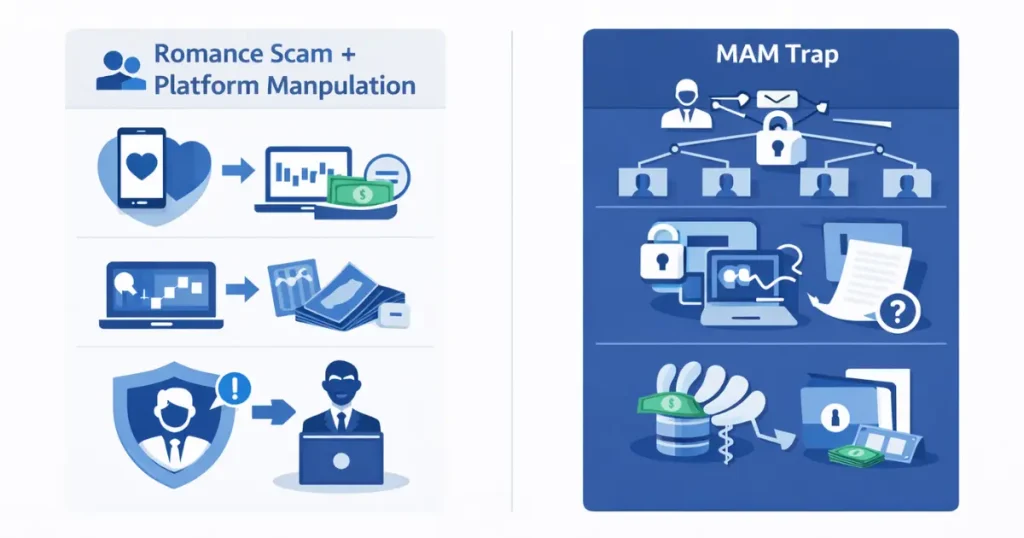
Understanding how these scams play out in real life can help you recognize warning signs. Here are two documented cases that illustrate common patterns:
Case Study 1: The Romance Scam + Platform Manipulation
“I was contacted through a dating app by someone who built a relationship over weeks. They eventually convinced me to try copy trading through their recommended platform. When I started copying their trades, the charts were manipulated and my entire deposit vanished. The next day, an ‘account manager’ demanded I pay the negative balance or face legal action. I had deposited $15,000 total.”
Warning signs in this case:
- Initial contact through dating/social platforms
- Relationship building before investment pitch
- Pressure to use a specific, unfamiliar platform
- Platform manipulation (charts don’t match real market)
- Threats and demands for additional payment
The FBI has warned about “pig butchering” scams (also called romance-investment scams) where fraudsters build long-term relationships before introducing fake investment opportunities.
Case Study 2: MAM Trap Disguised as Copy Trading
“I invested in what was advertised as copy trading. The trader stopped responding to messages months ago, but trading continues. My $50,000 account is now down to $4,000. I can’t stop the trades myself—the platform says I don’t have permission. The positions are clearly designed to generate cashback rebates for the trader, not profit for me. I can’t find any company address or phone number.”
Warning signs in this case:
- Promised copy trading, actually enrolled in MAM/PAMM
- Trader became unresponsive after receiving funds
- Unable to stop or control trades
- Suspicious trading pattern (rebate farming)
- No verifiable company information
This victim was trapped in a MAM arrangement without realizing it—watching their money disappear with no way to intervene.
5 Principles to Avoid Copy Trading Scams
The global copy trading market is projected to grow significantly, but this growth attracts fraudsters. Follow these principles to protect yourself:
1. Understand the System and Money Flow
- Confirm funds go to an account in YOUR name only
- Verify you can withdraw anytime without restrictions
- Ensure you can stop copying trades instantly
- Understand exactly how the trader gets compensated
- Never send money directly to an individual or unregulated entity
2. Verify Broker and Platform Legitimacy
- Check for regulation by CFTC, NFA, FCA, CySEC, or ASIC
- Verify the license number on the regulator’s official website
- Research the platform’s operating history (longer is better)
- Confirm fund protection/segregation policies
- Ensure physical address and contact information are verifiable
Important: A fancy website does not mean a platform is legitimate. Always verify regulatory status independently.
3. Never Respond to Unsolicited Investment Offers
- Reject all investment pitches from strangers on social media
- Ignore “exclusive opportunity” or “limited spots” marketing
- Be especially wary of approaches on dating apps (romance scam pattern)
- Decline investment offers from friends or acquaintances without thorough research
- Report suspicious contacts to relevant authorities
4. Make Data-Driven Decisions Only
- Evaluate risk management ability, not just win rate
- Accept reality: Only 5-10% of traders are consistently profitable
- Check for hidden unrealized losses before following anyone
- Review maximum drawdown and recovery time
- Avoid emotional decisions based on marketing or testimonials
5. Start Small and Scale Gradually
- Begin with the minimum amount to test the system
- Verify performance matches expectations before increasing investment
- Diversify—never put all funds with one trader
- Don’t invest more than you can afford to lose
- Monitor your account regularly, especially in the beginning
Where to Report Copy Trading Scams
If you believe you’ve encountered or fallen victim to a copy trading scam, report it to the appropriate authorities:
- CFTC (Commodity Futures Trading Commission): Report commodity futures and forex fraud
- SEC (Securities and Exchange Commission): Report securities-related investment fraud
- NFA (National Futures Association): File complaints against NFA members
- FBI Internet Crime Complaint Center (IC3): Report internet-facilitated fraud
- Federal Trade Commission (FTC): Report consumer fraud and scams
- Your state securities regulator: State-level enforcement
Early reporting can help authorities identify patterns and potentially warn other victims.
Frequently Asked Questions About Copy Trading Scams
Protecting Yourself is Your Responsibility
Copy trading can be a legitimate way to participate in financial markets, but the industry attracts sophisticated fraudsters targeting beginners. The three scam patterns covered here—hidden loss manipulation, fake reviews, and MAM/PAMM misrepresentation—account for the majority of copy trading fraud.
Remember these essential principles:
- Trust only verifiable data—not testimonials, not marketing, not promises
- Maintain complete control over your account at all times
- Verify regulatory registration independently before investing
- Start small and scale only after verifying performance
- Report fraud to help protect others
Your financial security ultimately depends on your own knowledge and vigilance. No legitimate opportunity requires you to act immediately, give up control of your funds, or trust strangers on social media.