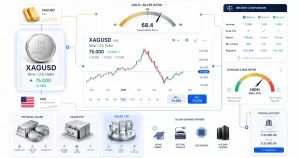




If you are asking how much is 1 lot of gold in XAU/USD, the short answer is simple: many brokers use 1 standard lot = 100 troy ounces of gold. That means the dollar value of 1 lot changes with the gold price itself.
For example, if spot gold is trading at $4,500 per ounce, then 1 lot is worth about $450,000. If gold is at $3,000, 1 lot is about $300,000. The contract is large, so beginners should understand lot size, pip value, and margin before placing even one live trade.
This guide explains the standard XAU/USD lot size, how to convert it into kilograms, how much 1 pip is worth, how margin is calculated, and how to verify broker specifications before using any lot-size formula.
- Typical retail CFD convention: 1.00 lot = 100 troy ounces
- At $4,500/oz, 1 lot is about $450,000
- If the broker defines gold as 0.10 = 1 pip, then 1 lot is usually $10 per pip
- Required margin depends on notional value divided by leverage
How Much Is 1 Lot of Gold in XAU/USD?
In most retail XAU/USD platforms, 1 standard lot represents 100 troy ounces of gold. Because XAU/USD is quoted in dollars per ounce, you can estimate the notional size with a very simple formula:
Gold lot value = gold price per ounce x 100 ounces
| Gold price | 1 lot notional value | 0.10 lot | 0.01 lot |
|---|---|---|---|
| $4,000/oz | $400,000 | $40,000 | $4,000 |
| $4,500/oz | $450,000 | $45,000 | $4,500 |
| $5,000/oz | $500,000 | $50,000 | $5,000 |
The key point is that lot size stays the same while notional value changes with price. A rising gold market automatically makes the same 1-lot position larger in dollar terms.
XAUUSD Contract Size by Broker: Often 100 oz, but Exceptions Exist
For most standard XAU/USD symbols, 1.00 lot commonly represents 100 troy ounces of gold. However, the contract size can change when the broker uses a cent account, micro account, mini symbol, or a symbol suffix.
Always check the exact symbol specification before using any pip value or margin formula.
| Broker (account type) | Symbol | Typical contract size | Exception to know | What to verify |
|---|---|---|---|---|
| Exness (standard) | XAUUSDm | 1 lot = 100 oz | Standard Cent can use 1 lot = 1 troy oz | Symbol suffix, account type, contract size, tick value |
| XM (standard) | GOLD | 1 lot = 100 oz | XM Micro account can use 1 lot = 1 troy oz | Micro vs standard account, contract size, minimum lot |
| Blueberry Markets (standard) | XAUUSD | 1 lot = 100 oz | Contract details can vary by entity, platform, and account | Contract size, tick size, margin rate, trading hours |
| Axi (standard) | XAUUSD | 1 lot = 100 oz | XAUUSD.min uses 1 lot = 10 troy oz | Standard vs .min symbol, lot step, tick value |
The important point is to check the exact symbol, not only the broker name. XAUUSD, GOLD, XAUUSDm, XAUUSD.min, or a cent-account version can have different contract size, tick value, and margin behavior even under the same broker brand.
How Many Grams Is 1 Lot of Gold?
One troy ounce is about 31.1035 grams. So a 100-ounce gold lot is approximately 3,110.35 grams, or roughly 3.11 kilograms. That helps beginners see just how large a standard lot really is.
If that feels too large, that is normal. Many traders use 0.01 lot or 0.10 lot instead of a full standard lot, especially while learning how gold behaves around CPI, NFP, FOMC meetings, and other macro events.
Gold Lot Size and Pip Value
Many brokers quote gold so that 0.10 dollars per ounce = 1 pip. If your broker uses that convention, the pip formula is:
Pip value = 0.10 x ounces traded
| Position size | Ounces | 1 pip | 10 pips |
|---|---|---|---|
| 0.01 lot | 1 oz | $0.10 | $1 |
| 0.10 lot | 10 oz | $1 | $10 |
| 0.50 lot | 50 oz | $5 | $50 |
| 1.00 lot | 100 oz | $10 | $100 |
This is why a standard lot can feel deceptively small on the trade ticket but large in real risk. A 30-pip move on 1 lot is typically about $300.
If you want the pip math step by step, read our detailed XAUUSD pip value guide.
How Much Margin Do You Need for 1 Lot of Gold?
Margin is not the same as the full notional value. It is the amount your broker requires to open the position. The usual calculation is:
Required margin = notional value divided by leverage
Using a gold price of $4,500/oz, 1 lot is worth $450,000. Margin changes dramatically depending on leverage:
| Leverage | Margin for 1 lot | Margin for 0.10 lot |
|---|---|---|
| 1:20 | $22,500 | $2,250 |
| 1:50 | $9,000 | $900 |
| 1:100 | $4,500 | $450 |
| 1:500 | $900 | $90 |
High leverage lowers the entry margin, but it does not reduce the real size of the contract. That is why beginners can blow up quickly on gold: the position is large even when the required deposit looks small.
Spread, Commission, and Holding Cost on 1 Lot
The notional size tells you exposure, but trading cost depends on spread, commission, and possibly overnight swap. If 1 lot is $10 per pip, the spread cost becomes easy to estimate:
| Spread | Cost on 1 lot | Cost on 0.10 lot |
|---|---|---|
| 1 pip | $10 | $1 |
| 2 pips | $20 | $2 |
| 5 pips | $50 | $5 |
That is why a broker with a small difference in gold spread can still create a meaningful long-term drag. If you hold positions overnight, swap can matter as much as spread.
How to Choose the Right Gold Lot Size
For most beginners, the better question is not whether 1 lot is available, but whether 1 lot fits the account size and stop-loss plan. A practical workflow looks like this:
- Decide how much account risk you can tolerate on one trade.
- Choose the stop-loss distance in pips based on structure, not emotion.
- Use pip value to back into the lot size instead of starting with 1.00 lot.
- Check margin and free margin before placing the order.
If you are still building your framework, start with our beginner guide to XAU/USD trading, review gold trading risk, and then connect the sizing math with the main drivers of gold price moves.