




Financial news constantly refers to a “strong dollar” or “weak dollar” — but what’s the benchmark? The answer is the US Dollar Index (DXY), a single number that measures the dollar’s strength against a basket of six major currencies.
This article explains how DXY works, its constituent currencies and weightings, the five key factors that drive it up or down, its correlations with gold, oil, crypto, and equities — plus a practical trading strategy.
What Is the US Dollar Index (DXY)?
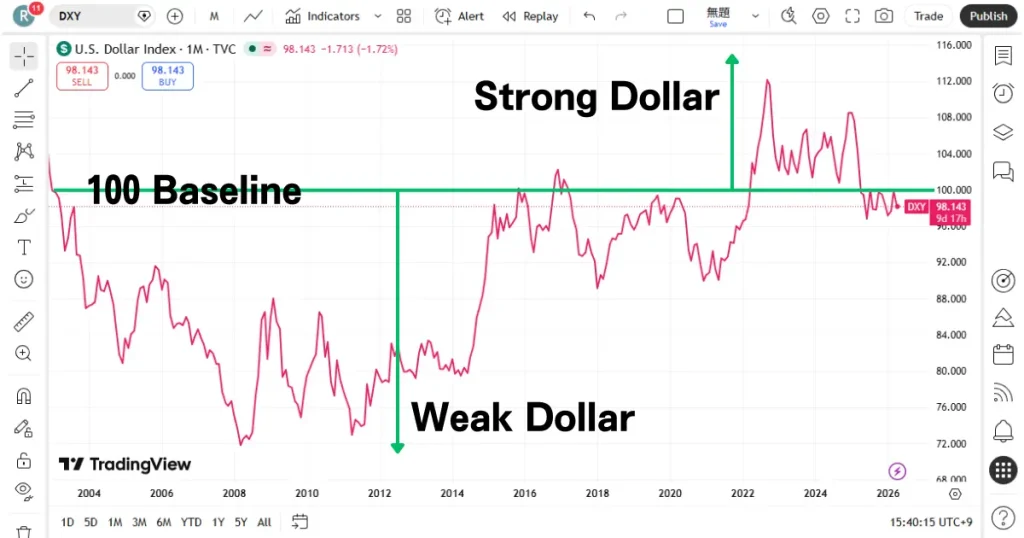
The US Dollar Index (DXY) measures the value of the US dollar relative to a basket of six major currencies. It was introduced by the New York Federal Reserve in 1973 with a baseline value of 100.
When DXY is above 100, the dollar is stronger than its 1973 baseline. When below 100, it’s weaker.
Constituent Currencies & Weightings
DXY is a weighted geometric mean of six currencies. Not all currencies carry equal weight — the euro alone accounts for nearly 58%, making EUR/USD movements the single biggest driver of the index.
| Currency Pair | Weighting |
|---|---|
| Euro (EUR/USD) | 57.6% |
| Japanese Yen (USD/JPY) | 13.6% |
| British Pound (GBP/USD) | 11.9% |
| Canadian Dollar (USD/CAD) | 9.1% |
| Swedish Krona (USD/SEK) | 4.2% |
| Swiss Franc (USD/CHF) | 3.6% |
5 Factors That Move the US Dollar Index
1. Federal Reserve Monetary Policy
The Federal Reserve’s interest rate decisions and balance sheet operations are the most powerful driver of DXY:
- Rate hikes → dollar strengthens → DXY rises
- Rate cuts → dollar weakens → DXY falls
- Quantitative Easing (QE) → more dollars in circulation → DXY falls
- Quantitative Tightening (QT) → fewer dollars in circulation → DXY rises
Markets are forward-looking — DXY often starts moving before the actual policy change, based on expectations alone.
2. US Economic Data
Key economic indicators like GDP, CPI (inflation), and Non-Farm Payrolls (NFP) directly influence dollar strength:
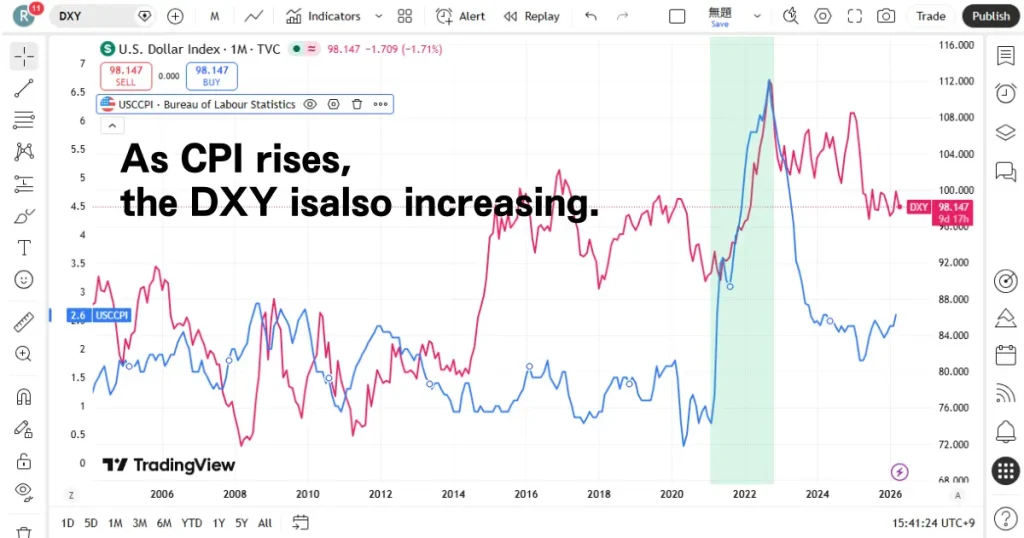
- Strong jobs data → economic optimism → dollar bought → DXY rises
- High CPI → inflation concerns → rate hike expectations → DXY rises
- Weak GDP → slowdown fears → dollar sold → DXY falls
3. US Government Policy (Trade & Tax)
The dollar is the world’s primary reserve and trade currency, so US policy decisions have outsized effects:
- Free trade + corporate tax cuts → increased global dollar demand → DXY rises
- Tariffs + protectionist policies → reduced confidence in the dollar → DXY falls
4. Fiscal Deficits & the Debt Ceiling
America’s fiscal health directly affects dollar confidence:
- Expanding fiscal deficit / debt ceiling deadlock → credit concerns → DXY falls
- Government shutdown → political risk → DXY falls
- Debt ceiling raised / fiscal discipline shown → confidence restored → DXY rises
5. Economic Conditions in Other Basket Countries
When other DXY constituent currencies strengthen, the dollar weakens relatively — and vice versa:
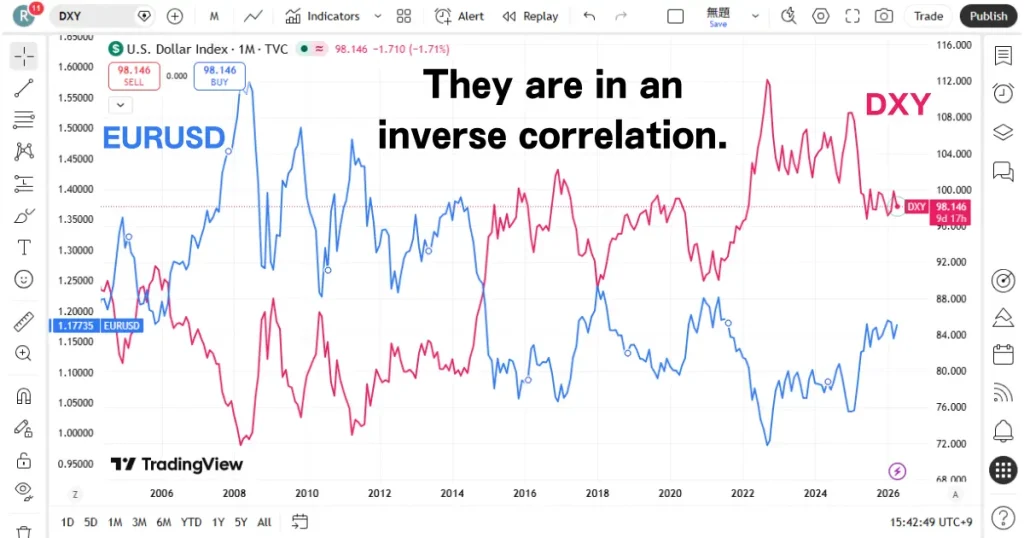
- ECB/BOJ rate hikes or strong eurozone/Japan data → EUR/JPY rise → DXY falls
- Recession or rate cuts in basket countries → their currencies weaken → DXY rises
DXY Correlations & How to Use Them
The dollar index isn’t just a currency metric — it has strong correlations with virtually every major asset class, making it an invaluable tool for cross-market analysis.
| Asset | Correlation with DXY |
|---|---|
| Gold (XAUUSD) | Inverse: DXY up → gold down; DXY down → gold up |
| Crude Oil | Inverse: DXY up → oil down; DXY down → oil up |
| Crypto (BTC) | Inverse: DXY up → crypto down; DXY down → crypto up |
| US Treasuries | Inverse: DXY up (rate hikes) → bond prices fall |
| US Equities | Positive (liquidity-dependent): DXY up → stocks up |
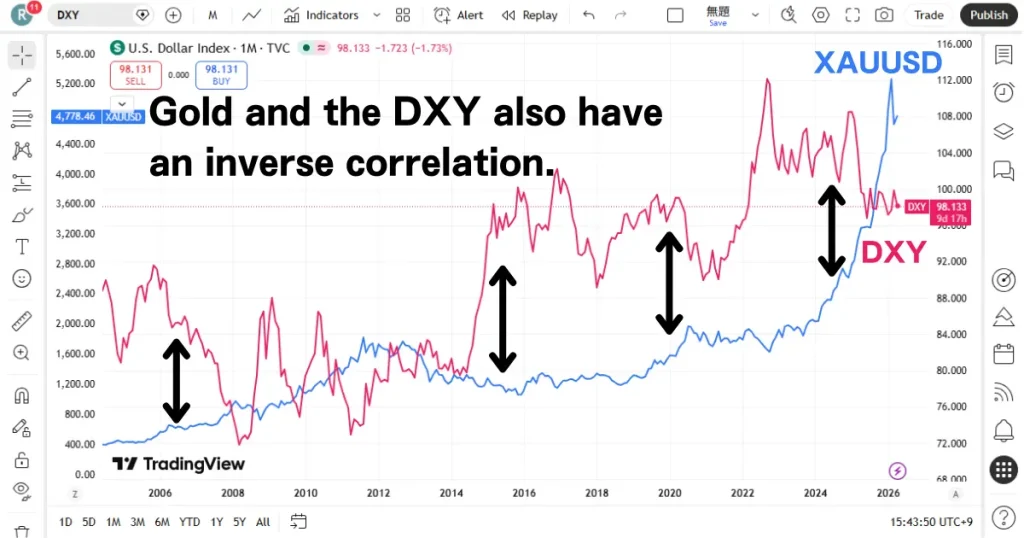
These correlations are general tendencies — market sentiment and geopolitical events can temporarily override them. For more on gold trading, see our gold (XAUUSD) trading strategy guide.
DXY Trading Strategy
DXY has a daily range of only 0.5–0.8%, making it less suitable for day trading and better suited for swing trading within a range.
Range-Trading Example
During a rate-cutting cycle, DXY tends to trend lower. A practical approach is to sell near resistance (previous highs) when the macro bias is bearish:
- Take profit at ~4% below entry
- Stop loss at ~2% above entry
- DXY typically oscillates within a ±5% range, so this 2:1 risk-reward ratio captures the range efficiently
US Dollar Index (DXY) FAQ