



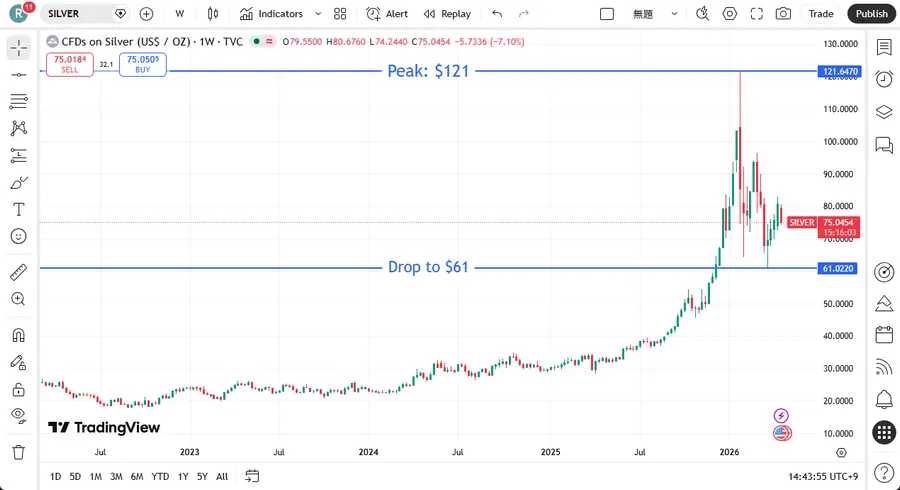
In January 2026, silver reached an all-time high of $121 per troy ounce — then plunged to the $60 range within just two months. These wild swings make silver one of the most volatile precious metals to trade, offering massive profit potential for traders who understand its unique dynamics.
This guide covers everything you need to start trading silver CFDs (XAGUSD) — from how CFDs compare to physical silver and ETFs, what drives silver prices, key trading strategies, and the best brokers for silver CFD trading.
What Is Silver CFD Trading (XAGUSD)?
A silver CFD (Contract for Difference) lets you speculate on silver price movements without owning physical silver. The ticker symbol is XAGUSD — XAG is the ISO currency code for silver, and USD means you’re trading silver priced in US dollars.
How to Buy Silver: Physical vs ETF vs CFD
| Physical (Bars/Coins) | ETF (e.g. SLV) | CFD (XAGUSD) | |
|---|---|---|---|
| Ownership | You hold the actual metal | Held in a brokerage account | Traded via a forex account |
| Storage cost | Yes (vault, insurance) | Expense ratio (~0.4–0.5%/yr) | None |
| Leverage | None (1x) | None (1x) | Up to 200–400x |
| Short selling | Not possible | Not possible (except inverse ETFs) | Yes |
| Trading hours | Dealer business hours | Exchange hours | Nearly 24 hours on weekdays |
| Ease of access | Requires a precious metals dealer | Requires a separate stock brokerage | Trade from your existing forex account |
| Overnight cost | None | None | Daily swap fees (unless swap-free) |
| Best for | Ultra-long-term wealth preservation | Medium to long-term investment | Short to medium-term trading |
For forex traders, the biggest advantage of silver CFDs is convenience. You can trade silver directly from your existing forex account — no need to open a separate brokerage. CFDs also let you go short, meaning you can profit when silver prices fall after a rally.
The trade-off is daily swap costs that accumulate when holding positions for weeks or months. For longer-term positions, consider using a swap-free account to eliminate these charges.
Key Features of Silver CFDs
- Nearly 24-hour trading — same session hours as gold and forex pairs
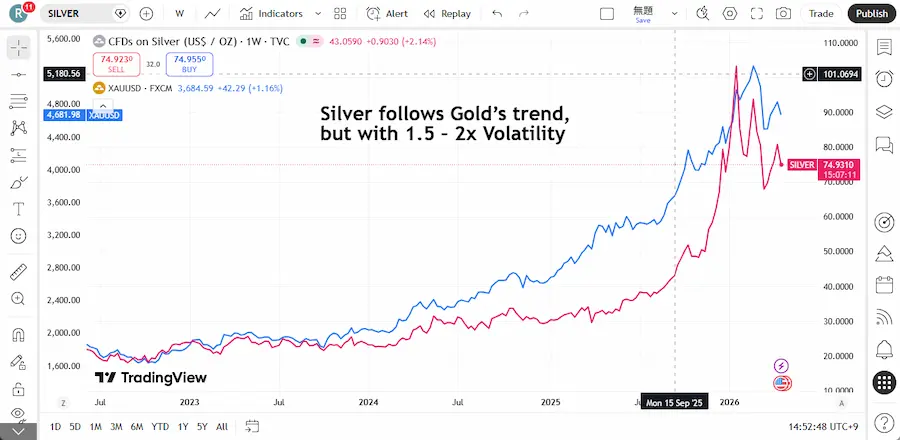
- High volatility — roughly 1.5–2x the volatility of gold
- Lower price per unit — silver trades around $60–70/oz vs gold at $3,000+/oz, making it accessible with smaller capital
- No physical storage — unlike bullion, CFDs have zero storage requirements
- Leverage available — trade larger positions with a fraction of the notional value
- Swap points — typically negative for longs, positive for shorts
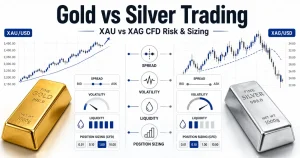
Gold vs Silver: Understanding the Differences
| Gold (XAUUSD) | Silver (XAGUSD) | |
|---|---|---|
| Price per ounce | ~$3,000–$5,400 | ~$30–$120 |
| Primarydemand | Safe haven, central bank reserves | Industrial use (~50–60%) + investment |
| Volatility | High | 1.5–2x gold’s volatility |
| Gold-silver ratio | — | Historical range: 50–80x |
| Key industrial uses | Minimal | Solar panels, electronics, EVs |
| Market size | Large | ~1/10 of gold’s market |
Silver Is an Industrial Metal
The biggest difference between gold and silver is their demand structure. While gold is primarily an investment and reserve asset, silver is the most electrically conductive metal, making industrial applications account for roughly 60% of total demand.
Solar Panels
The fastest-growing segment of silver’s industrial demand is solar photovoltaics. Silver is used as electrode paste in solar cells. According to the World Silver Survey 2026, solar PV consumed approximately 186.6 million ounces of silver in 2025 — though this figure has begun declining due to high-price thrifting and substitution technologies.
Electric Vehicles (EVs)
EVs use roughly 67–79% more silver than conventional vehicles — approximately 25–50 grams per car for battery management systems, power electronics, and charging infrastructure. With global EV adoption accelerating, this sector is expected to grow at 3.4% annually through 2031.
AI Data Centres & 5G
Silver is critical in high-performance GPUs, heat dissipation components, and 5G antenna signal transmission. As AI infrastructure scales globally, silver demand from this sector continues to rise.
Primary source: World Silver Survey 2025 (The Silver Institute / Metals Focus)
The Structural Supply Deficit
The global silver market has been in deficit for five consecutive years since 2021, with a cumulative shortfall of approximately 762 million ounces drawn from above-ground inventories. The core reason is that roughly 70% of silver is produced as a by-product of copper, lead, and zinc mining — even when silver prices rise, producers cannot easily ramp up silver-specific production.
This “demand keeps growing, but supply can’t keep up” dynamic is a key structural factor supporting silver’s long-term price outlook.
What Moves Silver Prices?
Gold-Silver Ratio
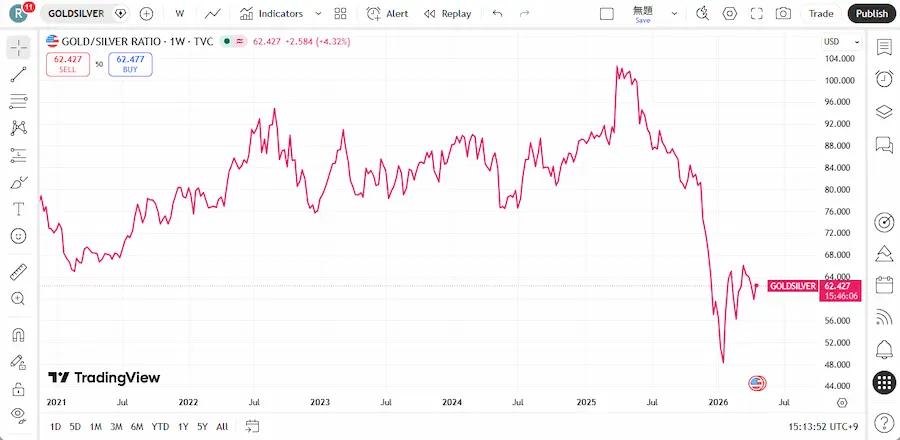
The gold-silver ratio (gold price ÷ silver price) is the most fundamental gauge of whether silver is cheap or expensive relative to gold. Historically, it fluctuates between 50x and 80x. Above 80x signals silver is undervalued; below 50x suggests silver is overvalued. In 2025, the ratio briefly topped 100x before contracting to 55–65x in 2026.
Fed Policy & the US Dollar
Silver is priced in USD, so Fed interest rate decisions and dollar movements have a strong impact:
- Rate cuts / weaker dollar → bullish for silver (bought as an alternative to fiat)
- Rate hikes / stronger dollar → bearish for silver (capital flows to dollar assets)
Silver reacts more violently than gold to the same catalysts due to its higher volatility. FOMC announcements are high-impact events for silver CFD traders.
Economic Data & Industrial Demand
Because ~60% of silver demand is industrial, silver is sensitive to global economic conditions:
- Economic expansion → higher industrial demand → bullish for silver
- Recession → lower industrial demand → bearish for silver
Key indicators to watch include China’s manufacturing PMI and global solar panel installation data.
Geopolitical Risks
Like gold, silver benefits from safe-haven demand during geopolitical crises. However, silver’s reaction is typically amplified — it follows gold’s direction but with larger percentage moves in both directions.
- Middle East tensions → safe-haven buying pushes silver higher
- US-China trade friction → dollar weakness helps silver, but industrial demand concerns can offset gains
- Instability in major silver-producing nations (Mexico, Peru) → supply disruption fears can directly drive silver prices up
Silver CFD Trading Strategies
Mean-Reversion Using the Gold-Silver Ratio
When the gold-silver ratio moves far outside its historical 50–80x range, you can position for a reversion:
- Ratio above 80x → silver is undervalued → buy silver
- Ratio below 50x → silver is overvalued → sell silver
This is a swing trading strategy (weeks to months). Since swap costs accumulate over time, consider using a swap-free account for these longer holds.
Trend-Following with Gold Correlation
Silver is strongly correlated with gold. When gold establishes a clear trend, silver tends to follow — but with 1.5–2x the price movement:
- Gold trending up → silver rises with larger percentage gains
- Gold trending down → silver falls with larger percentage losses
Confirming the trend on gold first, then entering on silver, reduces directional risk. However, silver’s larger swings mean you should use smaller lot sizes and wider stop-losses compared to gold trades.
For more on gold trading strategies, see our gold (XAUUSD) trading strategy guide.
Best Brokers for Silver CFD Trading
Here’s a comparison of three popular international brokers offering silver CFD trading. The most critical factor for silver is swap-free availability, since long-side swap costs can be substantial.
| Broker | Symbol | Max Leverage | Swap-Free | 1 Lot Size |
|---|---|---|---|---|
| XM | SILVER | 400x | Ultra Low account | 5,000 oz |
| HFM | XAGUSD | 100x | Not available for silver | 1,000 oz |
| Exness | XAGUSD | 2,000x | All account types | 5,000 oz |
Exness — 2,000x Leverage + Tight Spreads
Exness offers the highest leverage at 2,000x (reduced to 100x around major news events) and swap-free across all account types. Exness is well-known for competitive spreads and is suitable for everything from scalping to swing trading.
XM — Bonuses + Swap-Free on Ultra Low Account
XM offers silver under the symbol “SILVER” with up to 400x leverage. The Standard account provides welcome and deposit bonuses, while the Ultra Low account offers swap-free trading with tighter spreads — ideal for swing trading silver.
HFM — Bonuses Available, Lower Leverage
HFM trades silver as “XAGUSD” with 100x max leverage — the lowest among the three. Bonus accounts are available for deposit bonuses. However, silver is not eligible for swap-free on HFM. The 1-lot contract is 1,000 oz (vs 5,000 oz at XM/Exness), allowing smaller minimum positions.
How to Choose
- Want bonuses? → XM Standard or HFM Bonus account
- Swing trading (days to weeks)? → Swap-free is essential → XM Ultra Low or Exness
- High-leverage scalping? → Exness (2,000x)
- Best all-round? → XM (400x leverage + Ultra Low swap-free + tight spreads)
A practical approach: start with a bonus account to build capital, then transfer funds to a swap-free account with better trading conditions for your core silver positions.