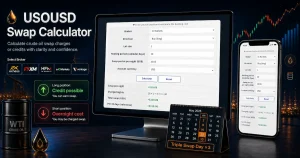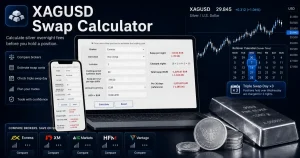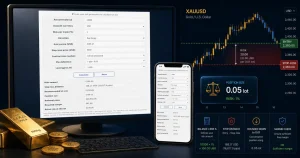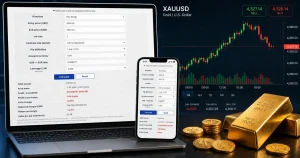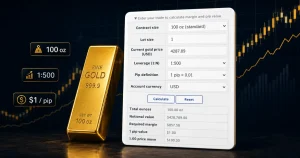





This bitcoin swap calculator answers the question almost every BTCUSD trader underestimates: what does it actually cost to hold a Bitcoin CFD overnight, and across a full month? Tell it how many BTC you are holding, your direction and your holding period, and it estimates the overnight financing in USD and your account currency. The headline most people miss: a Bitcoin CFD swap is usually negative and large — far bigger, dollar for dollar, than gold — because it bakes in crypto borrow and financing cost.
- Swap per night: the overnight cost (or credit) for your BTC quantity and direction — on Bitcoin CFDs this is almost always a cost
- Charged nights breakdown: every calendar day you hold counts ×1 — weekends included, with no triple-swap day (crypto trades 24/7)
- Total holding cost: for your full period, in USD and your account currency
- Auto-fill from broker: pick your broker and the latest measured swap drops in automatically — points, money-per-lot or annual-interest modes are all converted to USD per BTC per night
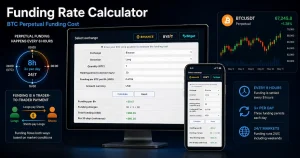
Margin is the cost of opening a position, profit is the result of closing it — swap is what quietly accrues while you simply keep it. And on Bitcoin that “keeping” cost is real money. The very same coin has a completely different overnight mechanic on a crypto exchange, where you pay or receive a funding rate instead of a broker swap — worth comparing before you decide where to hold.
| Broker | |
|---|---|
| Direction | |
| Quantity (BTC) | |
| Holding period (calendar days) |
|
| Swap per BTC (USD) | |
| Account currency | |
| USD → |
| Swap per night | |
|---|---|
| Charged nights | |
| Total swap (USD) | |
| Total swap () | |
| Per 30 days (reference) |
Trading a metal instead? The same engine, tuned for gold, lives in the XAUUSD Swap Calculator — a useful side-by-side for seeing just how much heavier Bitcoin’s overnight cost runs than a comparable gold position.
How the Bitcoin CFD swap works
Swap is the overnight financing adjustment your broker applies once per night at rollover. Because Bitcoin’s underlying market never closes, a BTC CFD is typically charged every calendar day — weekends included — with no weekend skip and no triple-swap day, unlike forex or gold. On a Bitcoin CFD the figure you should brace for is the nightly cost itself — it is routinely negative and large, because the swap embeds the cost of financing a leveraged crypto exposure. Treat it like a slow bleed, not a one-off spread.
The holding-cost formula
Total swap = swap per BTC per night × BTC quantity × charged nights
Charged nights = every calendar day you hold the position, weekends included — one charge per night, with no triple-swap day. The result keeps its sign, and on Bitcoin that sign is nearly always negative.
Here is the example I wish more people ran before opening a swing trade. If a broker’s swap is around −$45 per BTC per night on the long side, holding 1 BTC for 30 days costs roughly −$1,350 — every one of those 30 nights is charged, weekends included. In my experience traders mentally price the entry spread and stop there — but that −$1,350 is a separate, recurring tax on simply staying in the position, and it does not care whether the trade is winning or losing.
Why holding Bitcoin overnight is so expensive
Compared with gold, where a night might cost a few dollars per ounce-lot, Bitcoin’s swap is in a different weight class because it carries crypto financing and borrow cost on top of ordinary leverage. The cost also scales with the price of BTC: the higher Bitcoin trades, the larger the dollar exposure behind each unit, and the heavier the nightly charge tends to be.
If you are the type of trader who opens a position “to see how the week develops”, this is the line item that decides whether your idea even has room to work. Personally, I treat any Bitcoin CFD held longer than a few nights as a position that has to overcome its own financing first — the swap is effectively a head start the market gives the other side.
Points, money-per-lot, or annual interest — all converted
Brokers do not quote Bitcoin swap the same way. Some publish it as points, some as money per lot, and some as an annual interest percentage. That last mode is the one that trips people up: an interest-mode broker might quote about −18% per year, which on a roughly $100,000 BTC works out to near −$50 per night. The tool converts every mode to USD per BTC per night and preserves the sign, so you are comparing like with like instead of guessing what “−18%” means in cash.
For interest-mode brokers a reference BTC price is needed to turn the percentage into a nightly figure, and the tool derives that from live exchange mark prices rather than a number you have to type. Honestly, this is the step I would never want to do by hand at 1 a.m. — a single decimal slip on a six-figure notional throws the whole estimate off.
Why we use a live value instead of a stale table
Bitcoin swap moves around far more than a forex pair’s, because it tracks crypto funding conditions that can shift day to day. A swap table you copy this week can be meaningfully wrong next week. This tool fills in the latest measured value per venue, converts it into USD per BTC per night and keeps the sign — so the estimate reflects current financing rather than a figure of unknown vintage.
There is one more reason I lean on a live value here: the same Bitcoin has two overnight-cost mechanics depending on where you trade it. A broker CFD charges this swap once per night; a crypto exchange charges a funding rate that settles every eight hours — three times a day — and, because it is exchanged between traders rather than set by a broker, it can flip to paying you. Both accrue around the clock, but the frequency and the direction behave very differently, and the venue you pick changes the maths completely.