




This funding rate calculator answers the one number that quietly drains — or pads — a leveraged crypto account: what does it cost to hold a BTC perpetual position over your holding window? Enter your BTC quantity, direction, and how many days you plan to stay in, and it estimates the BTC perpetual funding you will pay (or be paid). Unlike a broker swap, funding on a perp is not a fee skimmed by the exchange — it is money exchanged directly between longs and shorts, every 8 hours, around the clock.
- Funding per 8h: the estimated cost or credit per funding settlement (every 8 hours) for your BTC size and direction, from the latest measured rate for the venue you pick
- Funding charges breakdown: 3 settlements per day (every 8h), 24/7 — three times the frequency of a once-a-day CFD swap, and exchanged between traders rather than charged by the venue
- Total funding (or credit): across your full holding period, in USD and your account currency
- Auto-fill per venue: pick Binance, Bybit or Bitget and the latest measured funding value is filled in — positive means longs pay, negative means longs get paid
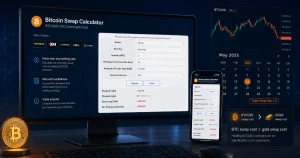
Margin is the cost of opening a position and PnL is the result of closing it — funding is what accrues while you simply keep a perp open. If you are coming from CFDs and expect “overnight = a flat broker fee”, a perp will surprise you: the cost floats with positioning and can flip to paying you. To see the contract-style version of this mechanic, compare the BTCUSD CFD Swap Calculator — same idea, very different behaviour.
| Exchange | |
|---|---|
| Direction | |
| Quantity (BTC) | |
| Holding period (calendar days) |
|
| Funding per BTC (USD) |
|
| Account currency | |
| USD → |
| Funding per 8h | |
|---|---|
| Funding charges | |
| Total funding (USD) | |
| Total funding () | |
| Per 30 days (reference) |
If you are still setting up an account to trade perps in the first place, the background walkthrough in How to open a Binance account covers the steps before you ever pay a cent of funding. Whether derivatives are even offered to you, and at what leverage cap, depends on your jurisdiction — treat the notices inside the app as the source of truth.
How perpetual funding works
A perpetual future never expires, so it needs a mechanism to keep its price tethered to spot. That mechanism is funding: every 8 hours the two sides of the market settle a payment between them. When the perp trades above spot, longs are crowded and longs pay shorts; when it trades below, the flow reverses and shorts pay longs. The exchange is only the messenger — it does not keep the money. That single fact is what makes a perp behave nothing like a broker’s overnight swap.
The holding-cost formula
Total funding = notional × funding rate × number of intervals, where notional = mark price × BTC quantity and there are 3 intervals per day. The daily figure is simply the per-interval rate × 3. The result keeps its sign: at a positive rate a long total comes out as a cost, while a negative rate turns the same long into a credit.
Example with illustrative numbers: at the common +0.01% per 8h baseline (about +0.03% per day), holding 1 BTC long on a roughly $100,000 mark costs about $30 a day, or roughly $900 over a month — and that $900 is paid to the shorts, not pocketed by the exchange. From what I have seen, this is exactly the figure CFD refugees underestimate, because their instinct says “overnight is a few dollars”, not nine hundred.
Why the cost can flip to paying you
Here is the part a swap table can never show you: when shorts get crowded and the perp slips below spot, funding goes negative, and the long side gets paid to hold instead of charged. Same position, same exchange — the sign just inverted because positioning did. Compared with a CFD swap, where the number is a broker policy that barely moves week to week, perp funding is a live readout of who is over-positioned right now. Personally, I would never lean on negative funding as income — it can normalise within hours — but ignoring its direction when you size a multi-day hold is leaving real money on the table.
3 times a day, every 8 hours — and why it adds up
This is where the cadence trips up traders arriving from forex or commodity CFDs. Both a BTC CFD swap and a perp accrue every calendar day, weekends included — but a CFD charges once per night, while a perp settles on an 8-hour interval, 3 charges a day. So a month on a perp is about 90 funding charges versus roughly 30 nightly swaps on a CFD: three times as many touch-points, and each one is re-priced from the live order book rather than set by a broker. If you are the type who opens a Friday swing and “lets the weekend ride”, note that a perp keeps billing three times a day straight through Saturday and Sunday. I find that cadence catches more newcomers than the rate itself does.
Why we use a live measured rate, not a stale table
Funding is not a fixed fee — it is reset every interval from the order book, and on a busy day the rate can swing several multiples between morning and night. A published “average funding” figure is therefore out of date almost as soon as it is written, and it usually hides the one thing that matters most: the sign. This tool fills in the latest measured rate for the venue you select, converts it to USD per BTC, and preserves whether you are paying or being paid. Honestly, I would trust a single live value over any tidy comparison table that does not say what time it was taken.
Frequently asked questions