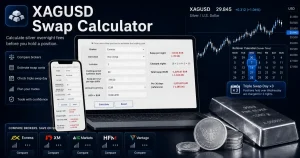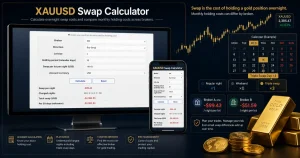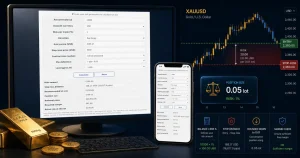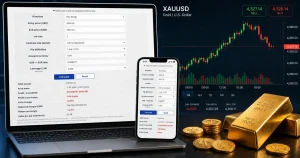





This crude oil swap calculator answers the question most WTI traders only ask after their first monthly statement: what does it cost — or pay — to hold this position overnight, and across a full month? It uses swap rates measured on our own MT5 accounts (not copied from a published table), counts the triple-swap day for you, and compares brokers side by side. Oil has a twist gold does not: holding long can sometimes credit your account instead of charging it.
- Swap per night: the measured overnight fee (or credit) for your lot size and direction — and on oil, a long can come back positive
- Charged nights breakdown: regular nights ×1, triple-swap day ×3, weekends ×0
- Total holding cost (or credit): for your full period, in USD and your account currency
- Auto-fill from broker: select your broker and the latest measured swap is filled in automatically — no manual lookup needed
Margin is the cost of opening a position, profit is the result of closing it — swap is what happens while you simply keep it. If you are still deciding whether to trade oil as a spot-style CFD at all, read How to Trade Crude Oil CFDs (WTI & Brent) first, then come back to size the overnight cost here.
| Broker | |
|---|---|
| Direction | |
| Lot size | |
| Holding period (calendar days) |
|
| Swap per lot per night (USD) |
|
| Account currency | |
| USD → |
| Swap per night | |
|---|---|
| Charged nights | |
| Total swap (USD) | |
| Total swap () | |
| Per 30 days (reference) |
Sizing a metal position instead? The same engine, measured for gold, lives in the XAUUSD Swap Calculator — useful for seeing exactly how differently oil and gold behave overnight.
How crude oil swap works
Swap (the overnight financing adjustment) is applied once per trading night at your broker’s rollover, with one weekday charged at triple rate to cover the weekend. On oil CFDs the surprise is rarely the size of a single night — it is the sign. Unlike most pairs, a long oil position can be paid rather than charged, which flips the usual “holding costs money” intuition on its head.
The holding-cost formula
Total swap = swap per lot per night × lots × charged nights
Charged nights = regular weekday nights ×1 + the triple-swap day ×3 + weekends ×0. The result keeps its sign: a positive nightly value becomes a positive total (a credit), a negative one becomes a cost.
Example with our measured data: hold 1 lot long for 30 days and, at a measured +$10.66 per night on one broker, the month works out to a credit rather than a bill — roughly +$340 over a typical 32-charged-night stretch. Flip to short on a different broker measured at −$154.74 per night and the same month turns brutal, well past −$4,900. From what I’ve seen, oil traders carry the gold reflex — “overnight always costs” — into a market where the long side can quietly run in their favour.
Why Friday usually counts triple on oil
Financing has to cover the days when the market is shut. On most oil CFDs the triple charge lands on Friday — the weekday whose rollover carries settlement across the closed weekend — which is a different day from the Wednesday that metals like gold typically use. One broker in our set shows no fixed triple day at all, spreading the adjustment differently, so do not assume every account behaves the same.
If you are the type of trader who opens a swing position on a Thursday and “sees how the week closes”, that Friday multiplier is exactly the night you are most likely to sit through. On a paying long it is a bonus; on an expensive short it is the most painful single charge of the week — worth checking before you hold over the weekend rather than after.
Long pays, short bites: oil’s asymmetry
This is where oil earns its own calculator. Across the brokers we measure, the long side clusters around zero-to-positive — +$10.66 and +$27.63 per lot per night on two of them, $0.00 on others — while the short side runs from a mild −$12.90 down to a steep −$154.74. One broker is fully swap-free, charging $0 on both sides. Compared with gold, where both directions usually cost something, oil’s payoff is lopsided: comfortable to hold long, expensive to hold short.
Personally, I would not pick a broker purely for a positive long swap — a few dollars a night vanishes the moment oil moves a dollar against you. But if you already lean long and plan to hold, a swap-free or positive-long account is a genuine, measurable edge over one that quietly drains the position each night. For persistent short holds, the swap-free option is the one I would reach for first.
Why we measure instead of quoting tables
Brokers publish oil swap in different units — points of different sizes, money per lot, or a currency-mode figure — and they revise the numbers day to day, often more aggressively on energy than on metals because the underlying futures curve shifts. Honestly, a published oil swap table can be stale within a week. This tool reads the value measured on our own MT5 accounts, converts it to USD per lot per night, preserves the sign, and shows you the measurement date instead of a copy-pasted number of unknown vintage.