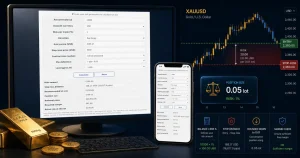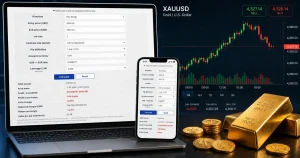





This free XAUUSD margin and pip value calculator turns the standard “1 lot = 100 ounces” fact into the numbers that actually affect your account: required margin, pip value, and notional value for your exact lot size, leverage, and broker contract size. Enter your figures and read the result instantly.
- Required margin: how much of your balance is locked to open the position at your leverage
- Pip value: how much one price move is worth, based on your broker’s pip definition
- Notional value: the full contract value you control (ounces × price)
- Account-currency margin: the margin converted into your own account currency
The contract size — 100 ounces per standard lot on most brokers — is the same number you see quoted everywhere. What changes from trader to trader is the margin and pip value once you apply your own lot size, leverage, and account currency. Enter your trade in the calculator below to see your own figures instantly.
| Contract size | |
|---|---|
| Lot size | |
| Current gold price (USD) | |
| Leverage (1:N) | |
| Pip definition | |
| Account currency | |
| USD → account currency rate |
| Total ounces | |
|---|---|
| Notional value | |
| Required margin | |
| Required margin (account currency) | |
| 1 pip value | |
| 1 full-dollar move |
For the full background on why 1 lot equals 100 ounces and how brokers quote gold, see XAUUSD 1 Lot Price: Contract Size, Margin & Pip Value Explained. To convert price moves into pips, use How to Calculate XAUUSD Pips. To estimate profit or loss from entry and exit prices, open the XAUUSD profit calculator.
XAUUSD contract size and margin at a glance
Here is how 1 lot breaks down across the three common gold contract sizes, using a gold price of $3,300 and 1:500 leverage. Use it as a quick cross-check against the result the calculator gave you.
| Broker setup | Contract size | 1 lot notional @ $3,300 | Margin @ 1:500 | 1 pip (0.01) |
|---|---|---|---|---|
| Standard (most brokers) | 100 oz | $330,000 | $660 | $1.00 |
| Mini | 10 oz | $33,000 | $66 | $0.10 |
| Micro | 1 oz | $3,300 | $6.60 | $0.01 |
Personally, I think the margin column is where most beginners get surprised. “1 lot of gold” sounds small until you see that a standard lot controls $330,000 of metal — and that a sharp move can swing your balance by hundreds of dollars per lot. If your figure above looked off, the contract size setting is the usual culprit.
How to use this XAUUSD calculator
Most brokers use 100 oz per standard lot. If your account is a mini or micro gold account, switch to 10 oz or 1 oz. If you are unsure, check the contract specifications page in your trading platform — this single setting changes every result.
Type your intended lot size (e.g., 0.10, 1.00), the current gold price, and your account leverage. If your jurisdiction caps leverage lower than the listed options, choose Other behaviour by entering your own figure in the price and reading margin proportionally.
Brokers disagree on what “one pip” means for gold. Pick the definition your platform uses — 0.01 is the most common for retail gold. If your account currency is not USD, select it and enter the current USD exchange rate to see margin in your own currency.
The formulas behind the calculator
Every output comes from three short formulas. Understanding them lets you sanity-check the result and adjust position size before you place an order.
Notional value and required margin
Notional = contract size × lots × price
Required margin = notional ÷ leverage
Example: 1 standard lot at $3,300 = 100 × 1 × 3,300 = $330,000 notional. At 1:500 leverage, margin = 330,000 ÷ 500 = $660. Honestly, the leverage figure is the part traders underestimate most — at 1:100 the same lot ties up $3,300, five times more buffer pressure.
Pip value
Pip value = contract size × lots × pip size
For a standard lot with a 0.01 pip definition: 100 × 1 × 0.01 = $1.00 per pip. If your platform treats 0.10 as one pip, the same lot is worth $10 per pip — same market, different label. If you are the type of trader who sizes stops in pips, set this correctly before you trust any risk number.
Account-currency conversion
Margin in account currency = USD margin × USD-to-account rate
Gold is priced in USD, so if your account is funded in another currency, your real margin depends on the exchange rate at the moment you open the trade. Compared to ignoring this, entering your actual rate gives a margin figure you can reconcile against your statement to the cent.
Frequently asked questions