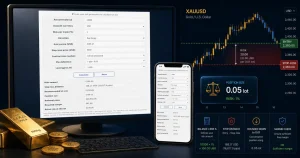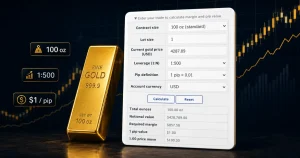




This free XAUUSD profit calculator answers the question every gold trader asks first: if price moves from here to there, how much do I make or lose? Enter your entry price, exit price, lot size, and direction — the tool shows profit or loss in USD, pips, your account currency, and price change % in one click.
- Profit / loss (USD): the dollar result for your entry-to-exit move, adjusted for buy or sell
- Profit / loss (account currency): the same result converted into the currency you fund your account with
- Pip equivalent: how many pips the favourable move represents under your broker’s pip definition
- Return on margin %: optional — if you enter leverage, see how the P/L compares to the margin locked at entry
Margin is the cost of opening a position; profit and loss is the result of closing it. If you want to see required margin and pip value first, use our XAUUSD Margin & Pip Value Calculator. This tool handles the outcome side — what happens when gold actually moves.
| Direction | |
|---|---|
| Entry price (USD) | |
| Exit price (USD) | |
| Lot size | |
| Contract size (oz/lot) | |
| Pip definition | |
| Account currency | |
| USD → account rate | |
| Leverage (1:N) optional |
| Total ounces | |
|---|---|
| Price move | |
| Profit/Loss (USD) | |
| Profit/Loss in pips | |
| Price change | |
| Required margin (USD) | |
| Return on margin | |
| Value per pip (reference) |
Indicative prices and exchange rates are for reference only — not execution prices. This tool does not constitute investment advice. Actual P/L depends on your broker’s spread, swap, commission, and fill price.
To understand pip definitions and how to count pips on gold, see How to Calculate XAUUSD Pips. For contract size and margin at entry, see XAUUSD 1 Lot Price and the margin calculator.
How gold profit and loss is calculated
Gold profit is simpler than most beginners expect — and that simplicity is exactly why traders skip the math and get surprised at the statement. The formula has three parts: ounces controlled, price change, and direction.
The core P/L formula
P/L (USD) = (exit − entry) × ounces × direction sign
For a buy, a higher exit means profit. For a sell, a lower exit means profit.
Example: buy 1 standard lot (100 oz) from $3,300 to $3,350. Price move = +$50. P/L = 50 × 100 = +$5,000. With a 0.01 pip definition, that is 50 ÷ 0.01 = 5,000 pips. Personally, I think seeing the pip count alongside the dollar figure is what makes position sizing click — 50 dollars sounds modest until you realise it is five thousand pips on a full lot.
Account-currency conversion
P/L in account currency = USD P/L × USD-to-account rate
Gold is quoted in USD. If your account is in another currency, the profit you withdraw depends on the exchange rate at close — not just the gold move. Compared to ignoring FX, entering your actual rate gives a P/L figure you can reconcile against your broker statement.
Return on margin (optional)
Margin at entry = entry price × ounces ÷ leverage
Return on margin % = P/L ÷ margin × 100
At $3,300 entry, 100 oz, and 1:500 leverage, margin = $660. A +$5,000 gain on that margin is +757.6% return — which explains why gold feels so volatile on a leveraged account. Honestly, this number is useful for sanity-checking risk: if your target P/L implies a return on margin above what you would accept on a single trade, the lot size is probably too large.
Quick reference: common gold moves
| Scenario | Move | 1 std lot P/L | Pips (0.01) |
|---|---|---|---|
| Buy, +$10 move | 3,300 → 3,310 | +$1,000 | 1,000 |
| Buy, +$50 move | 3,300 → 3,350 | +$5,000 | 5,000 |
| Sell, −$30 move | 3,350 → 3,320 | +$3,000 | 3,000 |
| 0.10 lot, +$20 move | 3,300 → 3,320 | +$200 | 2,000 |
If you are the type of trader who sizes take-profit in pips, run your target through the calculator before you place the order. A 200-pip target on 0.10 lot is +$200 — which may or may not match the risk you took on entry.