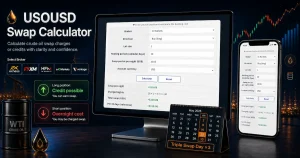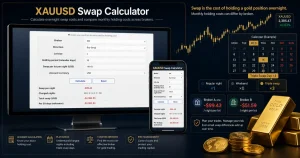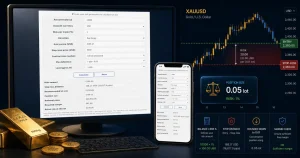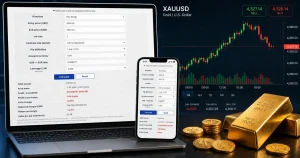





This XAGUSD swap calculator answers the question most silver traders only ask after their first statement lands: what does it cost to hold this position overnight — and for a month? It uses swap rates measured on our own MT5 accounts (not copied from a published table), counts the triple-swap day for you, and lines brokers up side by side so the gap is impossible to miss.
- Swap per night: the measured overnight fee (or credit) for your lot size and direction
- Charged nights breakdown: regular nights ×1, triple-swap day ×3, weekends ×0
- Total holding cost: for your full period, in USD and your account currency
- Auto-fill from broker: select your broker and the latest measured swap is filled in automatically — no manual lookup needed
Margin is the cost of opening a position, profit is the result of closing it — swap is the cost of keeping it. Silver is where that third cost bites hardest, because the per-broker spread on overnight swap is wider than on almost any other metal. If you want the underlying instrument explained first — contract size, the gold-silver ratio, what actually moves the price — read our silver CFD (XAGUSD) trading guide before you size a position.
| Broker | |
|---|---|
| Direction | |
| Lot size | |
| Holding period (calendar days) |
|
| Swap per lot per night (USD) |
|
| Account currency | |
| USD → |
| Swap per night | |
|---|---|
| Charged nights | |
| Total swap (USD) | |
| Total swap () | |
| Per 30 days (reference) |
Gold and silver share the same swap mechanics but not the same cost profile. If you also trade the yellow metal, the sibling XAUUSD swap calculator uses the identical measured-data approach so you can compare the two holding costs directly.
How silver swap is calculated
Swap (the overnight fee) is charged once per trading night at your broker’s rollover, with one weekday charged at triple rate to cover the weekend. The arithmetic is trivial; what catches people out on silver is how violently the per-night figure swings from one broker to the next.
The holding-cost formula
Total swap = swap per lot per night × lots × charged nights
Charged nights = regular weekday nights ×1 + the triple-swap day ×3 + weekends ×0.
Example with our measured data: holding 1 lot long for 30 days from a Wednesday gives 17 regular nights + 5 triple days = 32 charged nights. At a measured −$7.83 per night that is −$250.56; at −$204.45 it is −$6,542.40 — same metal, same month, and a bill more than twenty-six times larger. From what I’ve seen, that single broker choice swamps every other cost decision a silver swing trader makes; the spread you fret over at entry is a rounding error next to it.
Why one day counts triple
Spot positions settle two business days forward (T+2). A position rolled over on the triple-swap day — Wednesday for silver at the brokers we measure — has its settlement pushed across the weekend, so three nights of financing land at once. Weekends themselves charge nothing.
If you are the type of trader who opens silver mid-week and tells yourself it’s “just a few days”, look up which weekday the triple charge falls on before you click buy. On a long position at one of the expensive brokers, crossing Wednesday adds two extra nights of an already painful rate — that is the entry I’d personally time around.
Long bleeds, short sometimes pays
On silver, long swap is almost always negative — you pay to hold. Short is the interesting side: at some brokers it earns a small credit. Our measurements show short paying around +$6.73 per lot per night at one broker and +$14.25 at another, while elsewhere short simply lands at $0.00. Compared with chasing that credit, I’d treat it as a minor tailwind, not a strategy — a single day of silver’s own volatility can erase a month of short-swap income, so the direction should follow your view on price, not on financing.
Why we measure instead of quoting tables
Brokers publish silver swap in different units (points of different sizes, money, or percent) and nudge the values day to day. Honestly, published swap tables age fast — and on silver the gap between cheap and expensive is so large that a stale number can mislead you by hundreds of dollars a month. That is why this tool reads the value measured on our own MT5 accounts, converts it to USD per lot per night, and shows the measurement date instead of a copy-pasted figure of unknown vintage.