



This XAUUSD spread comparison is not copied from broker marketing pages. Every number below is measured on our own live MT4/MT5 accounts — sampled every 60 seconds, aggregated daily, and refreshed automatically on this page. The live table shows both the measured spread and the total cost after commission. Because spreads change with market conditions, the cheapest account can change from one measurement period to another.
- Live measured spreads: 15 account types across 7 brokers, updated daily from our own accounts
- True cost ranking: spread + commission combined into one per-lot number — the only fair way to compare raw/zero accounts against standard ones
- History chart: how each account’s measured spread has moved day by day — and whether the lowest-cost accounts stay near the top
XAUUSD spread comparison: 15 accounts, measured
The table ranks every account we measure by total cost of one round turn per 1 lot (100 oz): the measured spread in dollars × 100 oz, plus the official round-turn commission. The default view uses the 30-day measured average; switch to the latest daily reading when you want to inspect current conditions. The ranking follows the view you select and is recalculated as new measurements arrive.
| Broker / account | Spread | Commission (RT) | Cost per 1 lot |
|---|---|---|---|
| HFM InfinityX | $0.096 | $0 | $9.63 |
| Exness Zero | $0.040 | $11 | $15.02 |
| Exness Raw Spread | $0.080 | $7 | $15.02 |
| HFM Pro | $0.159 | $0 | $15.86 |
| Exness Pro | $0.168 | $0 | $16.83 |
| ThinkMarkets Standard | $0.191 | $0 | $19.09 |
| HFM Zero | $0.093 | $10 | $19.30 |
| Vantage Premium | $0.209 | $0 | $20.85 |
| Pepperstone Razor | $0.144 | $7 | $21.39 |
| Vantage Raw ECN | $0.159 | $6 | $21.86 |
| Exness Standard | $0.240 | $0 | $24.04 |
| Vantage Standard STP | $0.289 | $0 | $28.94 |
| XM Ultra Low | $0.303 | $0 | $30.29 |
| XM Standard | $0.553 | $0 | $55.31 |
Site-measured spread (ask − bid, USD) · commissions from official broker pages · measured 2026-07-29 · not investment advice
The tightest spread is not the cheapest account
A Raw or Zero account can show a narrower spread yet rank below a spread-only account once its metals commission is added. This is exactly the trap a spread number on its own sets for you: if a broker advertises “spreads from 0.0” without the commission on the same line, compare the total cost in the table before drawing a conclusion.
Same broker, double the cost
The account type matters as much as the broker. Standard accounts often build more cost into the spread, while Raw or Zero accounts may combine a narrower spread with a fixed commission. If you trade gold regularly, compare account types within the same broker before assuming that changing brokers is the only way to reduce costs.
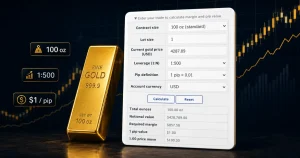
To estimate your own monthly cost, multiply the displayed total cost per lot by your lot size, number of round turns and trading days. Your result will change as spreads and account conditions change. For what the position itself wins or loses, see the XAUUSD profit calculator; for margin required, the margin & pip value calculator.
Five lowest-cost gold accounts by 30-day average
These are the five accounts at the top of the table’s 30-day average view, ranked by total cost per 1 lot. The positions and figures update automatically as new measurements arrive; the short verdicts describe each account’s characteristics and are not a substitute for checking the live table.
1. HFM InfinityX
30-day average spread $0.096 · round-turn commission $0 · total per 1 lot $9.63
| Max Leverage | Unlimited |
| stop loss level | 0% |
| commission | 0 |
| swap free | yes |
| min deposit | 500 USD |
| metatrader | mt4 / mt5 |
HFM's 2026 spread-only account is currently the cheapest gold row in our table — no commission, unlimited leverage and a surprisingly tight intraday range for a commission-free tier. Launch pricing this aggressive tends to get revisited, which is exactly why the table above re-ranks itself daily.
2. Exness Zero
30-day average spread $0.040 · round-turn commission $11 · total per 1 lot $15.02
| Max Leverage | Unlimited |
| stop loss level | 0% |
| commission | $11 RT (gold) |
| swap free | yes |
| min deposit | 1k - 3k USD |
| metatrader | mt4 / mt5 |
The thinnest raw spread we measure on gold — often pinned near $0.04 — but the $11 metals commission hands back everything the spread saves, so the all-in total matches Raw Spread rather than beating it. Worth it if you want near-zero spread at the moment of entry; on total cost alone it has no edge.
3. Exness Raw Spread
30-day average spread $0.080 · round-turn commission $7 · total per 1 lot $15.02
| Max Leverage | Unlimited |
| stop loss level | 0% |
| commission | $7 RT (gold) |
| swap free | yes |
| min deposit | 1k - 3k USD |
| metatrader | mt4 / mt5 |
Near-raw pricing with a flat $7 round-trip on gold — the fixed commission caps how expensive a volatile day can get, and the total ties Zero at the top of the Exness range. For gold I'd pick it over Zero: less of the cost is locked in, so calm days actually get cheaper.
4. HFM Pro
30-day average spread $0.159 · round-turn commission $0 · total per 1 lot $15.86
| Max Leverage | 1:2000 |
| stop loss level | 20% |
| commission | 0 |
| swap free | yes |
| min deposit | 100 USD |
| metatrader | mt4 / mt5 |
Commission-free with a mid-tier spread — and on gold it undercuts HFM's own Zero account once the $10 metals commission is counted. If gold is your main market at HFM, Pro is the sensible default; pure FX traders may still get better totals from Zero.
5. Exness Pro
30-day average spread $0.168 · round-turn commission $0 · total per 1 lot $16.83
| Max Leverage | Unlimited |
| stop loss level | 0% |
| commission | 0 |
| swap free | yes |
| min deposit | 1k - 3k USD |
| metatrader | mt4 / mt5 |
No commission, instant execution and a spread that stays disciplined through the day — in my experience the most set-and-forget of Exness's premium tiers. It needs a higher minimum deposit, which is the main reason I'd point a smaller account elsewhere.
XAUUSD spread history: watch the ranking move
The chart below plots the daily measured average spread of every account in the table, in dollars. The default view shows the five lowest-cost accounts in the 30-day average view — tick any other to add it; accounts of the same broker share a colour and differ by line style. Two things are worth watching over time: whether an account maintains its pricing and how far each account stretches on volatile days. The longest series now reach back to July 2025 and the chart gets more informative as the history grows.
How to read gold spreads: dollars, points and pips
From quoted spread to real money
The only conversion you need: spread in dollars × 100 oz × lots = cost per round turn. A $0.24 spread on 1 lot is $24 the moment you enter; on 0.1 lot it is $2.40. We publish spreads as plain dollars (ask − bid) precisely because that multiplication works the same at every broker — no pip-definition gymnastics required. If you want the full pip mechanics, we cover them in how to calculate XAUUSD pips.
Why “20 points” at one broker is not “20 points” at another
In our own feed, Exness quotes gold to 3 decimals (a point = $0.001) while HFM quotes 2 (a point = $0.01) — so “40 points” means $0.04 at one and $0.40 at the other, a 10× difference hiding behind identical wording. This is not an edge case; it is why point-based comparison tables mislead people. From what I have seen, dollars are the only unit that survives contact with more than one broker, which is how every number on this page is expressed.
Spread-only or commission account: the break-even math
Two pricing models, one number that matters
Standard-type accounts hide everything in a wider spread. Raw/zero-type accounts show a thin spread and charge a fixed commission per lot. Neither model is inherently cheaper — the winner is decided by the sum, and the sum changes by broker and market conditions. The live table lets you compare both models on the same total-cost basis.
Commission is the stable half of your cost
One under-appreciated property of commission accounts is that the fixed commission does not widen with market volatility. Spreads can stretch during news and thin-liquidity periods, while the commission remains fixed. This can make the cost structure easier to compare, but gold commissions are not always the same as the forex commissions shown in broker advertising. Always check the metals line in the official commission schedule and add it to the measured spread.
How we measure these spreads
Each broker column comes from a real trading account of that exact type, running on our own terminals. An EA samples ask − bid every 60 seconds during market hours, and the day’s statistics (average, minimum, maximum, sample count) are posted to this site hourly and finalized at the UTC day change. Days with only a fraction of a session — such as the two hours or so after the Sunday open, when spreads are structurally wide at every broker — are excluded from the chart and the 30-day averages so they don’t distort the comparison. Commissions are not measured — they are taken from the brokers’ official published schedules (verified July 2026) and rechecked when brokers announce changes. The feed began publishing in July 2026, and we have backfilled earlier days from tick history where brokers provide it — the oldest accounts now show data back to July 2025. The 30-day averages and the self-sorting table will keep getting more informative as history accumulates.
Spreads vary by account server, region and market conditions; your fills may differ. Figures are daily statistics from our accounts, not a guarantee of future pricing, and none of this is investment advice. Commission figures refer to the brokers’ international entities.
Frequently asked questions
Spread is the cost of entering a position. To complete the picture: holding costs in the XAUUSD swap calculator, position sizing in the lot size calculator, and what one lot of gold actually is in XAUUSD 1 lot price.