



Binance copy trading lets you mirror the spot and futures trades of experienced traders directly inside the world’s largest crypto exchange — without writing a single line of strategy code. Since the futures product launched in 2023 and spot followed in 2024, the feature has quietly become one of the more practical ways for newer traders to get exposure to active strategies while they still learn the ropes.
This guide walks through how Binance copy trading actually works in 2026, what it really costs once profit-share and slippage are factored in, how to pick a lead trader using metrics that matter, and how Binance stacks up against Bitget and Bybit. If you’re brand new to the concept, it helps to first read what copy trading is before diving in.
What is Binance Copy Trading and how does it work?
Binance Copy Trading is a built-in feature that automatically replicates the trades of a “lead trader” into your own account in near real-time. You choose a lead, allocate a budget, pick a copy mode, and the system mirrors their orders for you. You keep full custody of your funds — copied trades execute inside your wallet, not theirs.
What makes Binance different from a dedicated copy-trading platform is scale. You get the deepest crypto liquidity on the market, the same fee schedule you already use, and access to both spot and derivatives under one roof. The downside is that the lead-trader pool is smaller and less mature than Bitget’s, and the discovery UI still feels secondary compared to platforms built around copy trading from day one.
Spot copy trading vs futures copy trading
Binance offers two distinct copy products with very different risk profiles.
| Feature | Spot Copy Trading | Futures Copy Trading |
|---|---|---|
| Launched | 2024 | 2023 |
| Instruments | BTC, ETH, top alts (spot) | USDT-M perpetuals |
| Leverage mirrored | No (cash buys only) | Yes — including lead trader’s leverage |
| Liquidation risk | None | Yes — position can be liquidated |
| Profit share to lead | 10% of net profits | Up to 30% of net profits |
| Practical minimum | ~$500 | ~$1,000 |
If you’re new to leveraged products, I’d genuinely steer you toward spot copy trading first. Futures copy can be lucrative, but a leveraged lead trader can wipe a follower’s allocation in a single bad session — and you’ll have paid trading fees on the way down. Spot’s worst case is a drawdown on assets you actually own; futures’ worst case is a liquidation to zero.
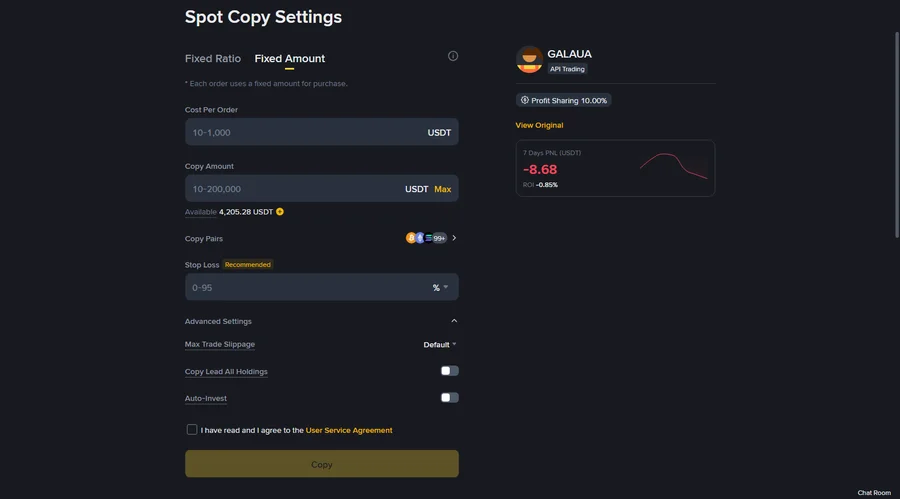
How copies execute (Fixed Ratio vs Fixed Amount)
When the lead trader opens a position, Binance’s engine pushes the same order into your account using one of two sizing methods:
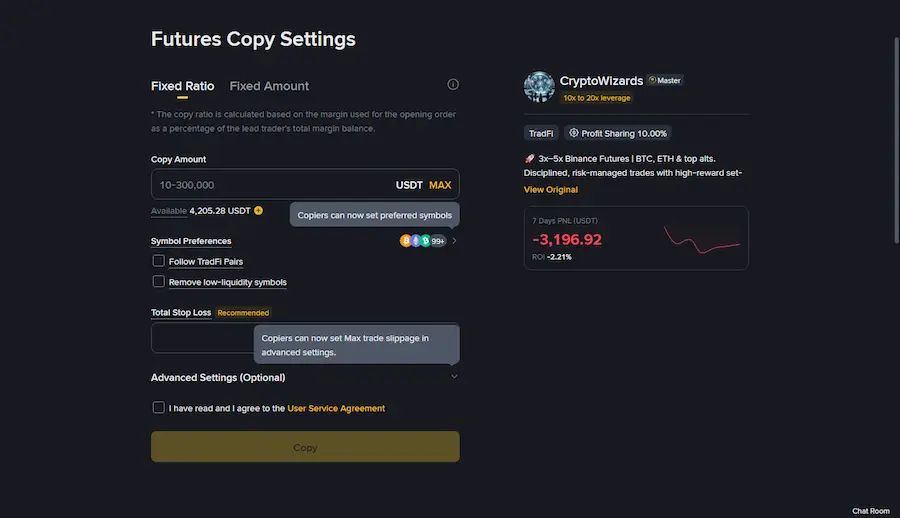
- Fixed Ratio: Your position is sized as a proportion of the lead trader’s. If the lead allocates 10% of their account to a BTC long, you allocate 10% of yours. This scales naturally with your bankroll and preserves the lead’s risk shape.
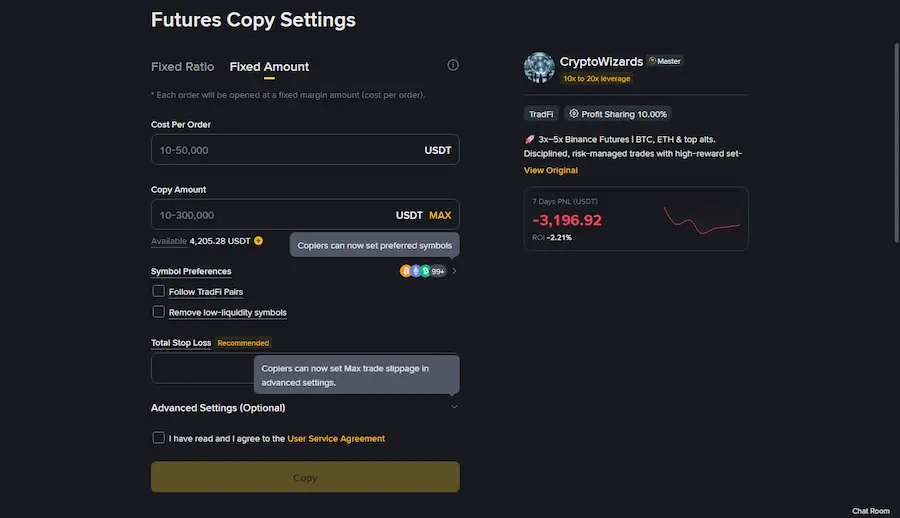
- Fixed Amount: Every copied trade uses the same notional amount (e.g. 50 USDT per position) regardless of what the lead actually risked. Safer for capping per-trade exposure but it can under-size during the lead’s best setups.
For most followers I lean toward Fixed Ratio — it preserves the lead trader’s actual risk shape, which is usually the reason you copied them in the first place. Fixed Amount is better if you specifically want to throttle aggressive leads or test a strategy with predictable, small risk per trade.
How to start copy trading on Binance (step by step)
If you already hold a Binance account, you can be copying trades within about fifteen minutes. The whole flow is designed to be friction-free for existing users — honestly Binance’s biggest single advantage over competitors here.
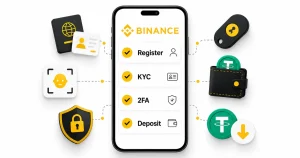
Step 1 – Account and KYC check
Copy trading requires a fully verified Binance account (intermediate KYC: ID document + face recognition). If you only completed basic verification, you’ll need to upload an ID document before the copy-trading menu becomes accessible. Approval is usually same-day. One practical note: if you plan to follow a futures lead, the futures account must be opened separately inside Binance via a short acknowledgement quiz — many newcomers miss this and wonder why the copy button stays greyed out. If you don’t have an account yet, our step-by-step guide to opening a Binance account covers registration and full KYC first.
Step 2 – Navigate to Copy Trading
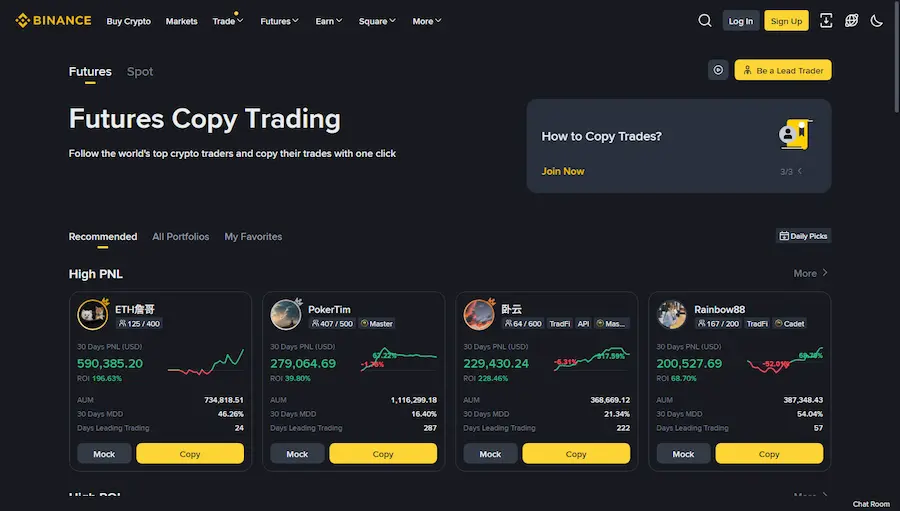
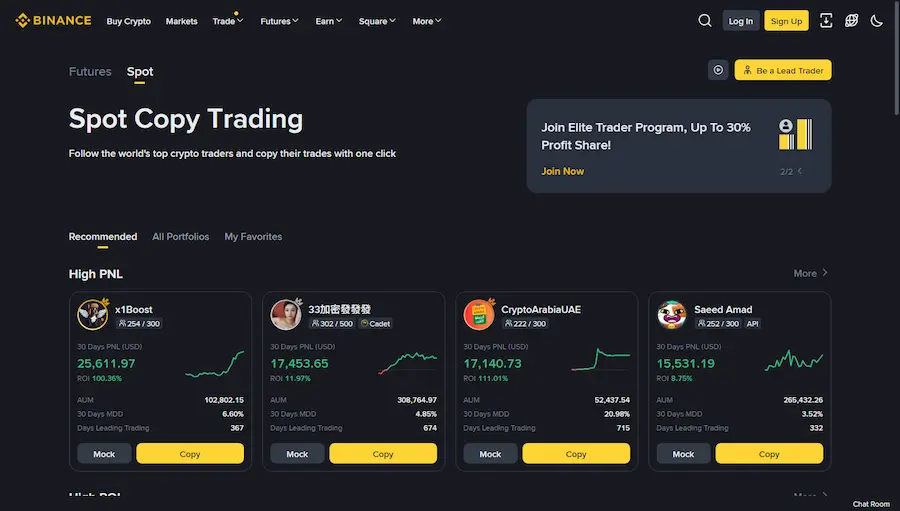
From the Binance top navigation, open Trade → Copy Trading. You’ll see two tabs: Spot and Futures. The Futures tab is significantly more populated — most active leads concentrate there because the profit-share economics favour them. Spot is calmer and, in my opinion, a better learning environment for first-time followers.
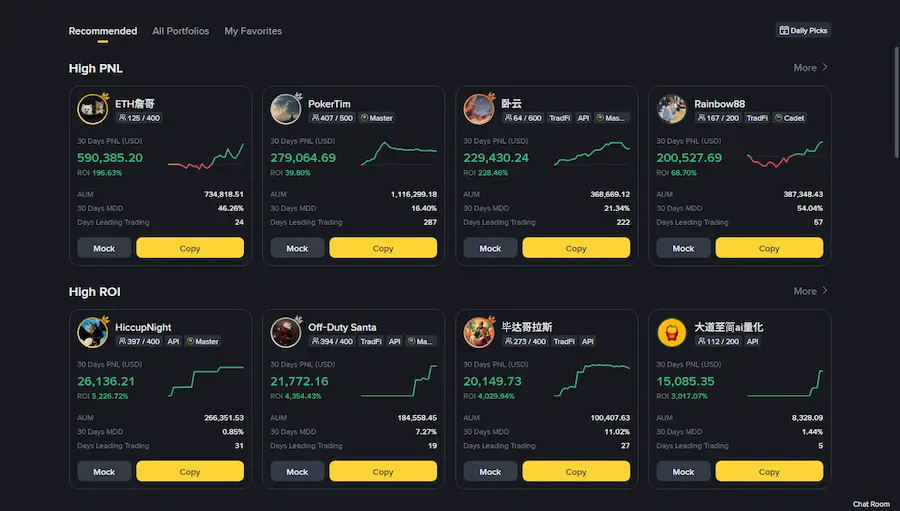
The discovery page lets you sort lead traders by ROI, PnL, follower count, and Sharpe ratio. Don’t trust the default sort — it tends to surface recent ROI spikes, which are exactly the leads most likely to blow up next month.
Step 3 – Choosing a lead trader (metrics explained)
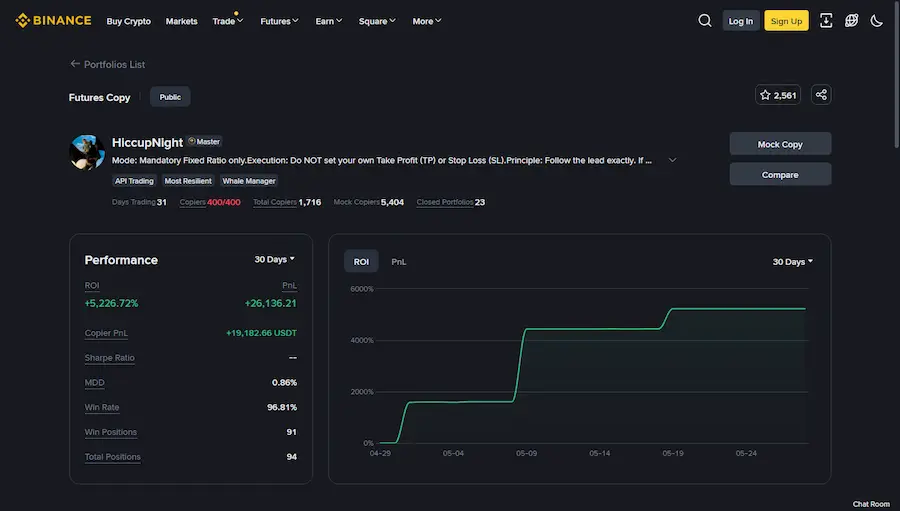
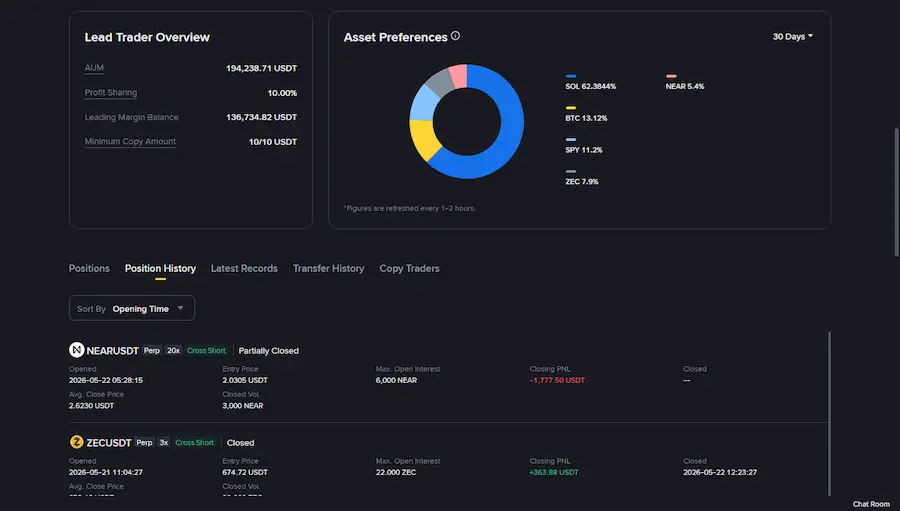
Clicking into a lead’s profile shows their full performance card — equity curve, win rate, average holding time, asset mix, and the actual trades they’ve taken. At this step you’re shortlisting two or three candidates whose style matches your tolerance for drawdown. The five metrics I personally weight highest are detailed in a dedicated section below.
If you’re the type who can’t stand watching your balance drop more than 15% even temporarily, ignore the high-ROI leads entirely. Their 200% annual returns come with 60% drawdowns; you will tap out before the recovery and crystallise the loss.
Step 4 – Setting budget and copy mode
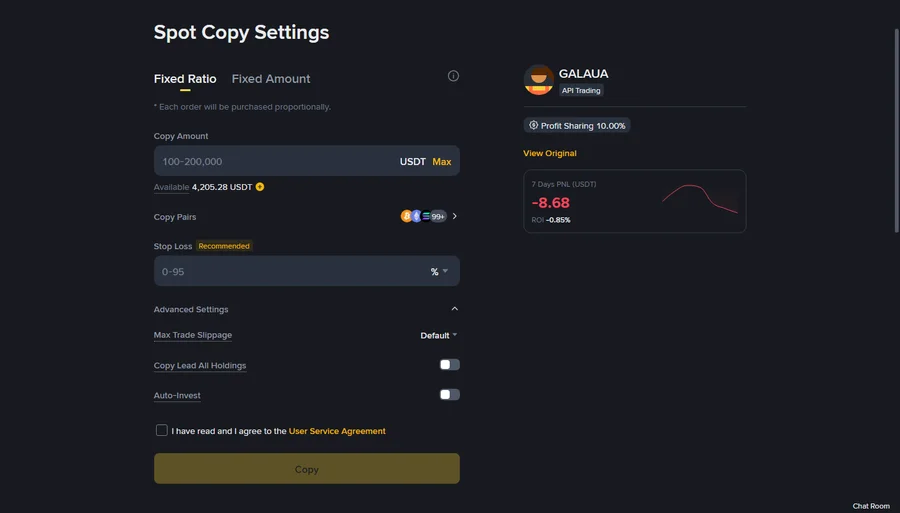
Binance requires a minimum follow of just $10, but that’s a marketing number rather than a useful one. Realistically you want at least $500 for spot copy and $1,000 for futures, otherwise position sizing rounds down to zero on the lead’s smaller trades and your performance diverges sharply from theirs. You can allocate up to 50,000 USDT per account and run up to 10 portfolios simultaneously. Diversifying across two or three uncorrelated leads usually smooths the equity curve and reduces single-trader blow-up risk.
Step 5 – Start copying and monitor positions
Once you confirm, copying starts immediately. New trades the lead opens going forward will mirror into your account; existing open positions are not copied retroactively. Spend the first week watching what happens — which pairs get traded, how long positions are held, whether slippage feels acceptable. Portfolio-level stop-loss settings give you a hard ceiling on damage if the lead’s strategy breaks down suddenly.
What does Binance copy trading cost?
The advertised cost of Binance copy trading is “just the profit share.” That’s not the whole story. There are three layers of cost stacked on top of each copied trade, and the slippage layer is the one almost nobody talks about until it hurts.
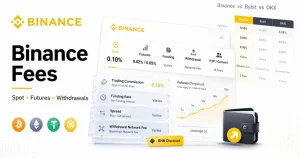
Trading fees (same as normal, BNB discount applies)
Copied trades pay the same maker/taker fees as any other trade in your account. Standard spot taker is 0.10%, futures taker is 0.05%, and you can knock 25% off either by paying fees in BNB. Full details are in the Binance trading fees breakdown. The kicker: the lead trader also receives a 10% rebate from your trading fees — so an active lead has an incentive to over-trade, because every copy fires fees you pay and they partially earn back.
The 10% profit share — how it compounds
On spot copy, the lead takes 10% of your net profits at each settlement. On futures, the cut can scale up to 30% depending on the lead’s chosen rate. “Net” means losses offset gains first — you don’t pay profit share on a period where you finish underwater.
The compounding effect matters. A lead delivering 30% gross annual returns hands you 27% on spot (after 10% share) or as low as 21% on futures (after 30% share), before trading fees. Honestly, this is why I’d only follow leads with demonstrable edge — a coin-flipper just transfers your money to them via fees over time.
Slippage: the cost nobody talks about
Copy trades execute a fraction of a second after the lead’s original order. For long-hold spot positions this barely matters. For high-frequency futures scalping, those few hundred milliseconds can mean entering 5–20 ticks worse than the lead — and exiting the same way.
Over a year, a scalp-heavy lead with 1,000+ trades can show a 40% return on their dashboard while followers net 15–20% because slippage quietly burns the rest. If a lead’s average hold time is under a few minutes, expect your copy performance to diverge substantially. Long-hold swing leads — hours to days per trade — are far less affected by this problem.
How to pick a good lead trader (5 metrics)
Most followers pick the trader with the highest 30-day ROI and act surprised when it doesn’t work out. Here’s what I actually look at, in priority order.
Here’s how brutal the filtering really is. When I went through Binance’s strategy list myself in June 2026, there were roughly 10,320 futures strategies and 2,540 spot strategies — plenty of choice at first glance. Filter for “running 180+ days” and futures drops to about 3,440, spot to about 1,860. Add “currently positive ROI” on top, and you’re left with roughly 800 futures and just 160 spot. That’s around 8% of futures strategies and 6% of spot ones that have both survived and stayed in the green. Out of more than ten thousand listings, the genuinely followable pool is a few hundred — which is exactly why the five metrics below need to be read together, not in isolation.
- Track record length (minimum 6 months, ideally 12+): Anyone can post a 200% month. A trader who’s stayed positive across a full cycle — bull, chop, and a real correction — has demonstrated something real. Binance shows the full history; use it.
- Maximum drawdown (under 30% preferred): The single most underrated metric. A lead with 80% annual ROI and 60% max drawdown is mathematically worse than one with 35% ROI and 12% drawdown, because you’d panic-unfollow the first one mid-drawdown and crystallise the loss.
- Sharpe ratio (above 1.5 is solid, above 2 is excellent): Risk-adjusted return. Filters out the leverage-junkies whose returns are just hidden volatility dressed up as skill.
- ROI consistency, not magnitude: Look at the monthly bars. A trader returning 3–8% every month is more replicable than one with a 60% month followed by two months of losses. Consistency compounds; volatility doesn’t.
- Follower count (sanity check, not a goal): Very low follower counts (under 50) on a long-running lead is a red flag. Extremely high counts (5,000+) mean their alpha is now crowded and slippage gets worse for everyone following simultaneously.
One extra thing I check that’s not on the official dashboard: whether the lead trader holds meaningful personal capital in the strategy. If their own skin-in-the-game is less than 500 USDT while managing tens of thousands in follower funds, the alignment of incentives is off.
Binance vs Bitget vs Bybit for copy trading
Binance isn’t the only game in town, and depending on what you want, it isn’t always the best fit.
| Feature | Binance | Bitget | Bybit |
|---|---|---|---|
| Lead trader pool | ~13,000 (spot + futures) | 130,000+ (largest) | Mid-sized, derivatives -focused |
| Products | Spot + Futures | Spot + Futures (copy-first design) | Futures -strong, MT5 channels |
| Profit share to lead | 10% spot, up to 30% futures | 8–10% | ~10% |
| Max follower allocation | 50,000 USDT | No fixed cap | Tier- dependent |
| Best for | Existing Binance users, spot beginners | Copy -trading -first users, max lead choice | Derivatives traders, MT5 integration |
For someone already holding funds on Binance, the friction of moving capital to a second exchange rarely justifies the marginally better lead-trader pool elsewhere. Binance wins on convenience alone. For someone starting from scratch specifically to copy trade, Bitget’s vastly larger lead pool and copy-first product design make it the more natural home. Between the two, Bitget edges ahead if copy trading is your only reason for picking an exchange.
FAQ
Conclusion
Binance copy trading is a genuinely useful tool when the right lead trader is paired with realistic expectations about cost and slippage. The platform’s strengths — liquidity, dual spot/futures access, an account you already use — make it the path of least resistance for existing users. Its weakness is a lead-trader pool that’s smaller and less battle-tested than Bitget’s, which matters more if copy trading is your sole reason for being on the exchange.
If you take one thing from this guide: don’t pick leads by ROI. Pick by drawdown, track-record length, and Sharpe — the boring metrics. Then size conservatively, diversify across two or three uncorrelated leads, and give the system at least a quarter before judging results. Copy trading rewards patience far more than aggression.