



Binance trading fees look simple on paper—0.10% spot, 0.02%/0.05% futures—but the real bill includes funding payments, P2P spreads, Convert slippage, and network withdrawal charges that never appear on the headline fee page. If you trade without mapping those layers first, a “cheap” exchange can quietly eat more edge than you expect.
This guide walks through every major Binance fee category for global readers outside the US: spot and futures commissions, VIP tiers, BNB discounts, P2P and Convert costs, deposit and withdrawal charges, and a side-by-side look at Bybit and OKX. Figures follow Binance’s published fee schedule as of early 2026—always confirm live rates under Fee Structure in your account, because promotions and product zones can override defaults.
How Binance trading fees are structured
Binance splits trading costs into maker and taker rates. A maker order adds liquidity to the order book—typically a limit order that rests until someone fills it. A taker order removes liquidity—usually a market order or an aggressive limit that matches instantly.
From what I’ve seen across thousands of fills, the maker/taker label matters more than the headline 0.10% number. Scalpers who always cross the spread pay taker on every leg; swing traders who patiently post limits can shave meaningful basis points over a year. The fee is always calculated on the filled notional (price × quantity), not on your wallet balance alone—so leverage on futures magnifies the cash fee even when the percentage stays fixed.
| Fee type | When it applies | Standard rate (VIP 0) |
|---|---|---|
| Spot trading | Each filled spot order | 0.10% maker / 0.10% taker |
| USDT-M futures | Each filled perpetual/ futures order | 0.02% maker / 0.05% taker |
| Funding | Open position at funding timestamp | Typically ±0.01%–±0.03% every 8h (varies) |
| P2P | Peer fiat trades | Taker 0%; Maker 0.15%–0.35% |
| Convert | Instant swap | No line-item fee; spread 0.05%–0.5% |
| Crypto withdrawal | On-chain transfer out | Flat fee by coin & network |
Binance spot trading fees
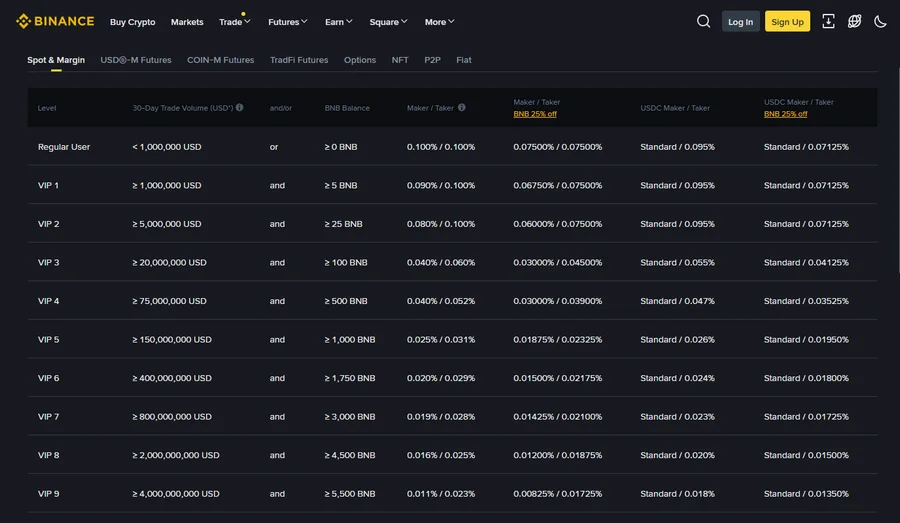
Standard rates: 0.10% maker and taker
At VIP 0, Binance charges 0.10% on both maker and taker for standard spot pairs. On a $10,000 buy, that is $10 per fill. A round-trip (buy then sell) costs roughly $20 in commissions alone—before any spread or slippage.
Personally, I treat 0.10% as the baseline and work backward: if my average target per trade is 0.5%, fees consume one-fifth of that edge on a single round-trip. That math is why high-frequency spot strategies often migrate to limit orders or lower-fee venues once volume grows.
VIP tiers: from VIP 1 to VIP 9
Binance lowers spot rates as your 30-day trading volume and BNB balance rise. From VIP 1 upward, both conditions must be met simultaneously—VIP 1 requires ≥ $1,000,000 in 30-day spot volume and ≥ 5 BNB. VIP 9 demands ≥ $4,000,000,000 in 30-day volume and 5,500 BNB—solidly institutional territory.
| VIP level | Spot maker | Spot taker | 30d volume / BNB |
|---|---|---|---|
| VIP 0 | 0.100% | 0.100% | < $1M or ≥ 0 BNB |
| VIP 1 | 0.090% | 0.100% | ≥ $1M and ≥ 5 BNB |
| VIP 2 | 0.080% | 0.100% | ≥ $5M and ≥ 25 BNB |
| VIP 3 | 0.040% | 0.060% | ≥ $20M and ≥ 100 BNB |
| VIP 4 | 0.040% | 0.052% | ≥ $75M and ≥ 500 BNB |
| VIP 5 | 0.025% | 0.031% | ≥ $150M and ≥ 1,000 BNB |
| VIP 6 | 0.020% | 0.029% | ≥ $400M and ≥ 1,750 BNB |
| VIP 7 | 0.019% | 0.028% | ≥ $800M and ≥ 3,000 BNB |
| VIP 8 | 0.016% | 0.025% | ≥ $2B and ≥ 4,500 BNB |
| VIP 9 | 0.011% | 0.023% | ≥ $4B and ≥ 5,500 BNB |
Honestly, VIP 9 is irrelevant for most retail traders—the volume gate is institutional. VIP 1–3 is where active spot traders actually land, and even there the savings are modest unless you churn large notionals daily.
BNB discount: cut spot fees to 0.075%
Enable “Use BNB to pay for fees” in your account settings and Binance applies a 25% discount on spot trading fees. That drops the effective rate from 0.10% to 0.075% for both maker and taker (before VIP stacking).
The catch: you need BNB in your wallet, and the discount applies only while the toggle is on. If BNB runs out mid-session, you revert to full price without warning. I keep a small BNB buffer—enough for a month of estimated fees—so I never get caught paying full freight on a busy trading day.
Buy $5,000 of ETH at taker rate with BNB discount: $5,000×0.075%=$3.75.
Same trade without BNB: $5.00. Over 200 trades per month, that gap exceeds $250.
Binance futures fees and funding
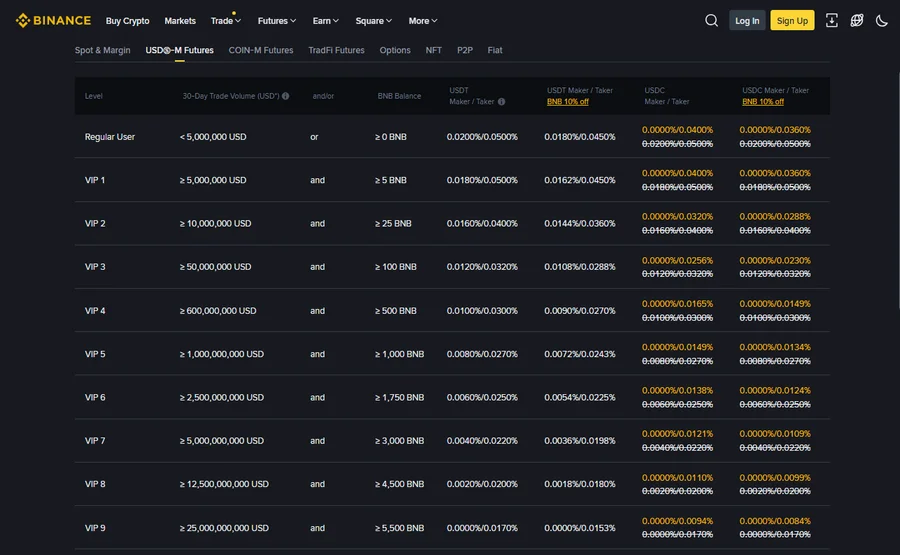
USDT-M perpetual: 0.02% maker / 0.05% taker
Binance futures fees on USDT-margined perpetual contracts are lower than spot: 0.02% maker and 0.05% taker at VIP 0. Because futures use leverage, the fee applies to full notional—a 10× position on $1,000 margin controlling $10,000 notional pays the percentage on $10,000, not $1,000.
If you’re the type of trader who opens and closes several times per session, taker fees stack fast. Against XAUUSD trading costs or other volatile CFD-style products, the commission line is smaller—but funding can dwarf it if you hold through multiple intervals.
Extra 10% off with BNB on futures
With BNB fee payment enabled, futures commissions get an additional 10% discount, bringing effective rates to roughly 0.018% maker and 0.045% taker. VIP 9 futures takers can reach as low as 0.017% with maker at 0%—again, a tier most readers will never touch, but useful context when comparing institutional quotes.
Compared to spot’s 25% BNB cut, the futures discount feels stingy—but on high-leverage scalps, even 0.005% saved per side adds up when you’re turning over six-figure notionals weekly.
Funding rate: the cost traders forget
Funding is not a trading fee. It is a periodic payment between longs and shorts on perpetual contracts, typically settled every 8 hours (though some symbols differ). Rates usually swing between ±0.01% and ±0.03% per interval depending on market sentiment—positive funding means longs pay shorts; negative means the reverse.
Picture this: you hold a $50,000 long through three funding windows at +0.03% each. That is roughly $45 in funding alone—potentially more than your trading fees for the same position. I close or hedge before major funding spikes on overheated altcoins; the trading fee is the visible line item, but funding is the silent budget killer on multi-day holds.
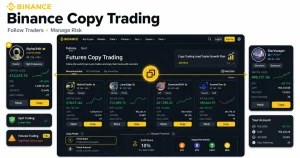
Binance also offers copy trading on futures, where follower fees mirror the underlying strategy’s trading costs—funding still applies to open copied positions exactly as it would on manual trades. For the full follower fee and 10% profit-share breakdown, see our Binance copy trading guide.
P2P and Convert fees
P2P: free for takers, 0.15%–0.35% for makers
On Binance P2P, takers pay 0% platform fee when buying from an existing advertisement. Makers who post ads and wait for buyers pay 0.15%–0.35%, varying by fiat currency and region.
For most users acquiring crypto with local bank transfer, acting as taker is the cost-efficient path. The real P2P cost is often the price premium embedded in the ad—not the platform fee line. I always compare the effective rate (ad price vs spot index) before confirming; a “zero fee” trade at 1.2% above index is worse than spot with 0.075% commission.
Convert: spread is the hidden fee
Binance Convert shows no separate commission, but the quote includes a spread of roughly 0.05%–0.5% depending on pair liquidity and volatility. Thin altcoin pairs sit at the wide end; BTC/USDT conversions during calm markets hug the low end.
Honestly, Convert is fine for small, one-click rebalances under a few hundred dollars. Above that, I post a limit on the spot book and earn maker pricing—the spread savings often beat Convert’s convenience tax.
Deposit and withdrawal fees
Crypto deposits: free on Binance
Binance does not charge a platform fee for standard crypto deposits. You still pay network fees on the sending side—if you withdraw from another exchange, that venue’s outbound fee is your cost, not Binance’s.
Withdrawal fees by network
Binance withdrawal fees are flat charges set per coin and network. They adjust with blockchain congestion—always check the withdrawal screen before confirming.
| Asset / network | Typical withdrawal fee | Notes |
|---|---|---|
| BTC (Bitcoin) | 0.0002– 0.0005 BTC | Varies with mempool congestion |
| ETH (ERC-20) | 0.003– 0.01 ETH | Often expensive; consider L2 routes if supported |
| USDT (TRC-20) | ~1 USDT | Popular low-cost stablecoin route |
| USDT (BEP-20) | ~0.8 USDT | Slightly cheaper BSC option |
For frequent movers of stablecoins, TRC-20 and BEP-20 USDT are the pragmatic choices—ERC-20 USDT can cost $5–$15 equivalent when Ethereum gas spikes. I batch withdrawals when possible: one $1 TRC-20 fee beats five separate $1 charges.
Fiat rails
Bank card purchases and third-party fiat gateways carry provider-specific fees shown at checkout—often 1%–3% plus spread. P2P bank transfer avoids Binance’s platform fee but may include bank charges on your side. Treat fiat on-ramps as a separate cost line from trading commissions.
Five practical ways to reduce Binance fees
1. Turn on BNB fee payment
The single highest-impact toggle for retail users. Twenty-five percent off spot and ten percent off futures, instantly—no volume requirement. Keep enough BNB to cover estimated monthly fees.
2. Use limit orders to earn maker rates
On futures, maker (0.02%) vs taker (0.05%) is a 60% reduction per fill. On spot VIP 1+, maker drops to 0.09% while taker stays 0.10%. Patience at the keyboard literally pays—unless your limit crosses the spread and still fills as taker, which happens more than beginners expect.
3. Climb VIP tiers organically
Manufacturing wash volume to chase VIP status usually destroys more edge than it saves. If your natural 30-day volume approaches a tier threshold, though, consolidating activity on Binance for that month can unlock lasting rate cuts.
4. Choose cheap networks for withdrawals
TRC-20 and BEP-20 USDT dominate for cost-sensitive transfers. Verify the receiving wallet supports the network—sending BEP-20 USDT to an ERC-20-only address is an expensive mistake no fee discount fixes.
5. Buy crypto via P2P as taker
Zero platform fee on the taker side, plus competitive ads if you filter by completion rate and volume. Compare the all-in price against card checkout before committing—P2P wins on fees but not always on speed or convenience.
How Binance fees compare to Bybit and OKX
Headline VIP 0 rates cluster tightly across major offshore exchanges. Differences show up in discount mechanics, funding behavior on your specific altcoin, and how quickly you can reach lower tiers—not in a single magic number on a blog post.
| Exchange | Spot maker / taker | Futures maker / taker | Native token discount |
|---|---|---|---|
| Binance | 0.10% / 0.10% | 0.02% / 0.05% | BNB: −25% spot, −10% futures |
| Bybit | 0.10% / 0.10% | 0.02% / 0.055% | Native token discounts available |
| OKX | 0.08% / 0.10% | 0.02% / ~0.05% | OKB: up to −40% |
Binance edges Bybit slightly on futures taker (0.05% vs 0.055%). OKX offers a lower spot maker at 0.08% before token discounts. I lean toward Binance when I need deepest liquidity and P2P depth; for pure futures taker scalping, Bybit’s funding tables on certain pairs occasionally work out cheaper on a given week—worth a live comparison rather than a permanent verdict.
Running two accounts is legal in many jurisdictions but adds operational overhead. If you split venues, track fee tiers separately and avoid leaving idle capital on the wrong exchange.
FAQ
Bottom line
Binance trading fees are competitive at headline level, but your actual cost stack includes BNB discounts, maker vs taker behavior, funding on held futures, P2P premiums, Convert spreads, and withdrawal network choices. Map all six layers before scaling volume—and compare alternatives if your style (heavy taker futures, frequent stablecoin moves) fits another venue better. And if you’re just getting started, our guide to opening a Binance account walks through registration, KYC, and 2FA first.